

“You won’t need a doctor when I’m done, you’ll need a priest.”
Mixing humor with sorrow, pop entertainment with grave horrors, Hollywood polish with creative flourish, Sleepers takes us on a soul-wrenching journey that explores the bonds of friendship and the way society shapes its youth. Abounding with moral dilemmas, it never asks or persuades the audience to choose sides, it merely suggests we grieve that evils such as child abuse exist. Directed by Barry Levinson, who had been working through a bit of a slump, Sleepers is based on Lorenzo Carcaterra’s controversial biographical novel of the same name. The veracity of the book came under dispute immediately upon release and it drew criticism from the Catholic Church due to an unflattering depiction of a priest. Indeed, one might be tempted to dismiss the film on the grounds that it’s been discredited, or to critique its narrative credibility considering its contrivances were not crafted to adhere to a set of facts. But if one can manage to juggle the fact that it is both a slickly written Hollywood production and a vehicle for tackling extremely uncomfortable topics it may prove a worthwhile experience.
Sleepers unfolds in three distinct acts. Initially a breezy coming-of-age tale set in Hell’s Kitchen circa 1966, it takes a horrifying plunge into abuse at an all-boys detention center, then shifts to a courtroom drama more than a decade later in its climactic arc. In my estimation, the acts are arranged in order of decreasing merit, as Levinson deftly evokes the bygone 1960s and creatively portrays the harrowing events at the boys home but lets the legal shenanigans drag on for too long.
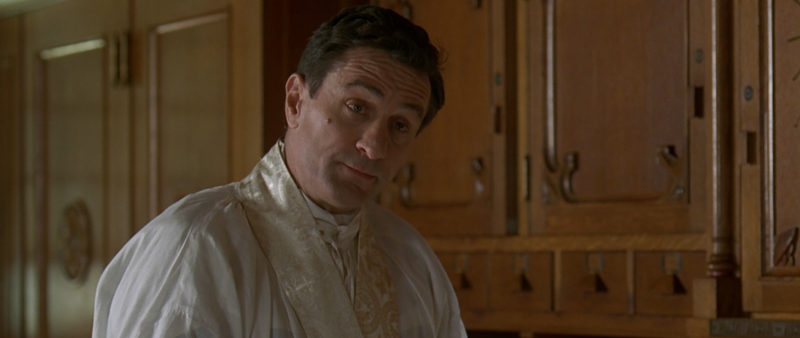
In the hazy summer days of the 1960s New York, four adolescent boys share in the misery of their troubled childhoods—Lorenzo “Shakes” Carcaterra (Joseph Perrino), Tommy Marcano (Jonathan Tucker), Michael Sullivan (Brad Renfro), and John Reilly (Geoffrey Wigdor). Jason Patric, who plays the older Carcaterra, offers Scorsese-esque narration that describes the world of Hell’s Kitchen with its two separate powers, the mob and the Church. Every child learns respect for both and that crimes against fellow citizens of their poor, working class neighborhood are strictly forbidden. Shakes and his pals steal sundry items, play stickball, talk about sex, pull pranks, and shoot hoops with Father Bobby (Robert De Niro). Despite the priest’s efforts to shepherd his boys toward lives of righteousness, they begin running errands for a gangster named King Benny (Vittorio Gassman).
Each arc has a focal point, an event around which the boys’ entire world hinges. In the first act this turning point comes when the boys severely injure a man while half-heartedly trying to steal a hotdog cart from a street vendor on a broiling hot summer day. “Sweet Jesus! What have you boys done?” a woman exclaims. “What in the name of God have you boys done?” Despondently, Michael says, “I think we just killed a man.” They’re found guilty of reckless endangerment and sent to the Wilkinson Home for Boys in Upstate, N.Y. where they meet Sean Nokes (Kevin Bacon), a sadistic monster who enjoys the companionship of young boys and happens to have unfathomable authority over too many of them. This is the watershed of act two—a distressing, prolonged torment that harms the spirits, minds, and bodies of the young boys and fundamentally alters their worldviews and personalities. The scenes of abuse are not graphic but sufficiently disturbing for a film otherwise crafted for mass appeal. John Williams’ mournful score perfectly underlines the tone along with looming scenes of implied dread and blurred flashbacks to these terrible moments.
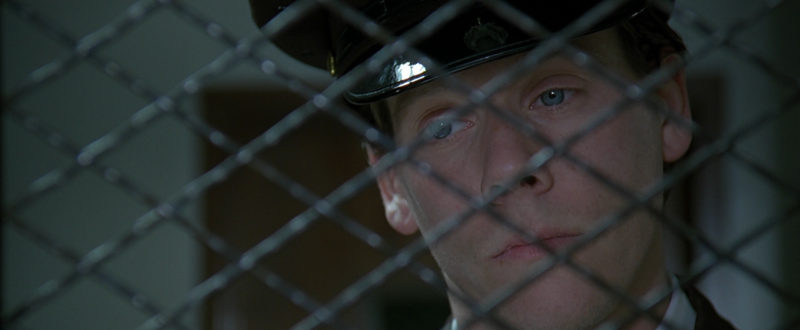
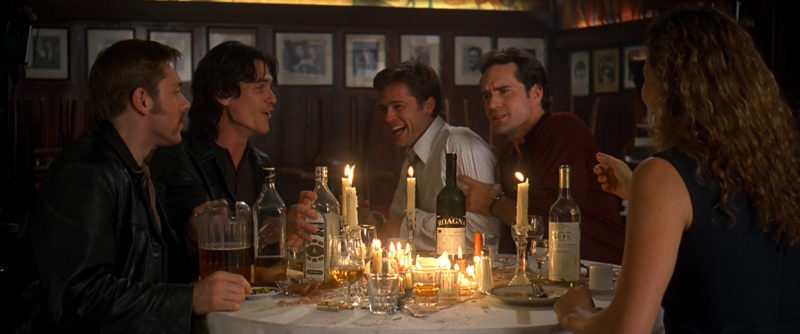
But Sleepers doesn’t so much dwell on the act of child rape as its effects. Three other men aided and participated with Nokes in his despicable crimes, among them Ralph Ferguson (Terry Kinney), who finds himself called to the witness stand when John (Ron Eldard) and Tommy (Billy Crudup), now career criminals, unexpectedly run into Nokes in a bar and unload a few pistol clips into his belly gangland-style. Problem is they didn’t take into account that there was a middle-aged couple eating dinner ten feet away who are pretty certain they saw what they saw. Michael (Brad Pitt), who is now an assistant D.A., takes the case with the hidden intention of botching it while also shifting the focus of the trial toward the Wilkinson Home for Boys. Michael refuses to speak to his old friends so that it will play better in court, but King Benny ensures that Michael is off-limits even though it appears he is breaking the golden rule of living in Hell’s Kitchen. Shakes (Patric), now an investigative journalist, makes a concerted effort to find an airtight witness to testify that John and Tommy were not at the bar that night. Along with Carol (Minnie Driver), a childhood friend of the boys, he requests that good old Father Bobby lie under oath. The moral conundrum plays out on Father Bobby’s face as he considers the hierarchy of evil into which he must foray. Dustin Hoffman, the last high profile actor to appear, assumes the role of a washed up, bumbling, substance-abusing lawyer who handles the scripted defense in court.
Despite the needlessly protracted final act and the too-perfect execution of the far-fetched legal trap, Sleepers makes it to a bittersweet capstone with its emotional resonance intact. It’s a vigilante picture at heart, but one that operates on a much different plane than most other films that fit that description. In fact, the main appeal of vigilante justice in entertainment—the moment that our broken young men enact their revenge—is not exciting at all. It’s downright sickening because we know, despite killing the man that had stolen the promise and potential they had as children, they will never have it back. In fact, as Father Bobby correctly intuits, they’ll immediately return to their life of crime. It’s this inner turmoil that is stirred within Father Bobby, as notions of conscience, loyalty, and religious vows conflict with one another, that makes Sleepers such a stirring picture. Ultimately, it doesn’t matter if Carcaterra’s a Puzo-inspired hack or telling the truth; the provocative story lands either way. At the very least, putting the maybe-true-maybe-not discussion aside, it’s an eminently watchable crime drama featuring a number of high-caliber stars working at a high level.