
“If you don’t help me, you’re going to wind up with this miniaturized submersible pod floating around your insides with this teeny tiny human skeleton at the helm.”
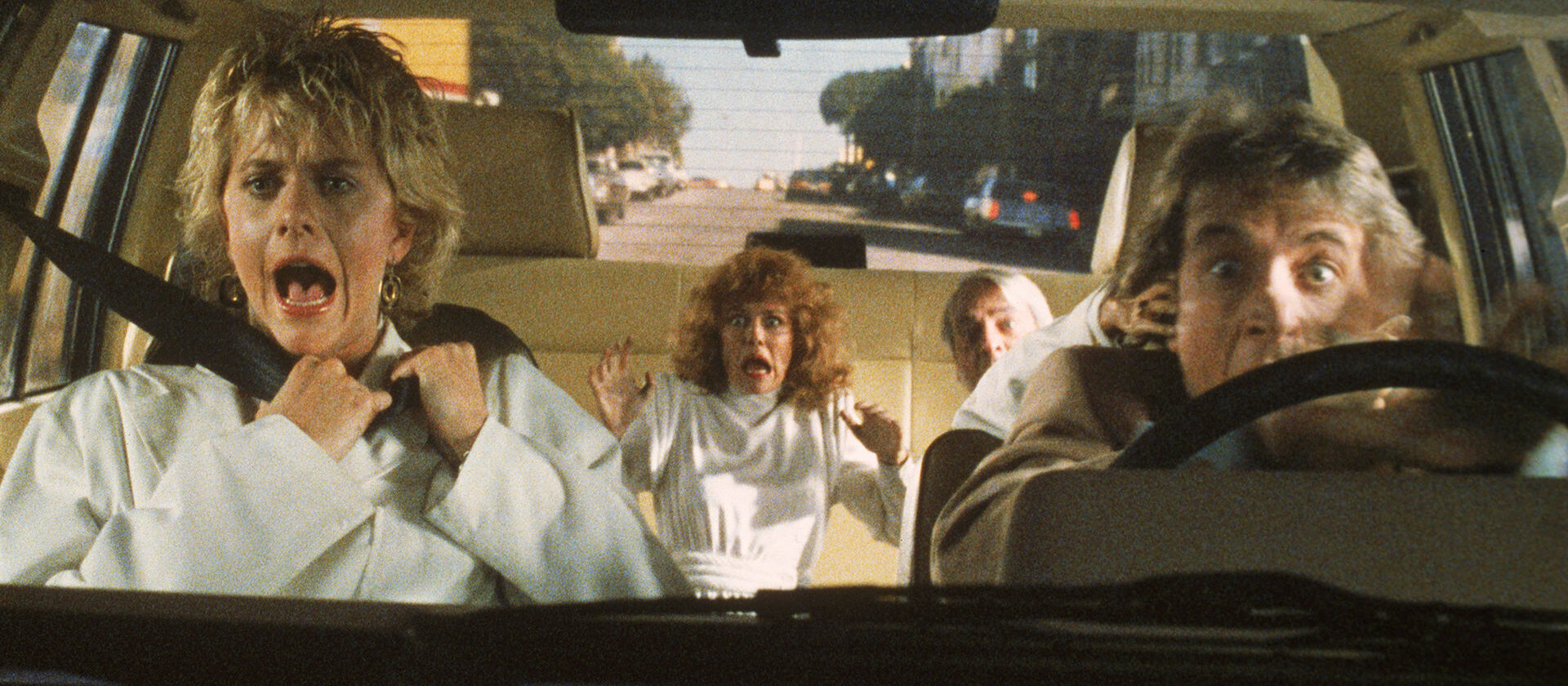
On the periphery of Innerspace, you’ll find agonizing hints of the weird and wacky film that Joe Dante seemed to really want to make—a subtle fixation on bunny rabbits; a cameo from ace Warner Bros. animator Chuck Jones; weaponized cyborg appendages (we get a literal finger gun and a propane blowtorch, the latter accompanied by the line, “In lieu of champagne, how about some real pain? Propane?”); an incidental furry convention; a posh dog that eats at his master’s table; half-shrunken villains riding on one another’s shoulders like a totem pole of midgets in a trench coat in order to reach a payphone; an outrageous stunt sequence where a motorcycle zips between a spread-legged Martin Short who is stretched between the swinging back door of a refrigerated truck and the windshield of Meg Ryan’s convertible. This is a Looney Tunes world years before Dante helmed Looney Tunes: Back in Action.
But all of this is happening more or less on the margins of an updated Fantastic Voyage storyline that injects a microscopic Dennis Quaid into the body of a hypochondriac grocery store clerk (Short), who, after concluding that he is not possessed by a demon but inhabited by a disgruntled, alcoholic military aviator with relationship problems, gets tangled up in all sorts of shenanigans involving caricatured goons (Robert Picardo, Vernon Wells) and flamboyant saboteurs (Kevin McCarthy, Fiona Lewis).
It’s obvious what drew Dante to the material—the opportunity to explore and transgress the human body through the medium of a live-action cartoon action movie. However, working under the aegis of producer Steven Spielberg after their successful collaboration on Gremlins, Dante’s natural tendencies seem to have been severely checked here. Anything that might be slightly gross or prurient or unsettling about one human putzing around inside another’s body is eschewed for buddy comedy and weightless sentiment as Quaid guides his host around by supplanting his ego, each half of the duo helping to solve the other’s problems. This isn’t really Dante’s bag, and it shows at times, most especially when Quaid finds himself transferred into the body of his girlfriend (Ryan) and discovers the fetus of his unborn child. It should be an extraordinary, transcendent moment, but the director seems almost embarrassed that he had to include it.
Those qualms aside, it’s hard to deny the background weirdness, the charisma and chemistry of the lead performers (incredible considering they only share the screen for about two seconds at the end), the inventive practical effects, or the zany action sequences. Not to mention the deceptively complex challenge in both scripting and direction of rendering many of these scenes intelligible at all; of making Quaid’s solo performance feel integrated with the bugnuts scenarios unfolding in the regular-sized world. While it might not deliver on the premise in quite the way you’d expect a Joe Dante film to, it’s consistently engaging and good-natured and fun, ripping through a dense narrative at a brisk clip with charm to spare. This is solid low-stakes entertainment even if it’s not great cinema per se, and I’d gladly return to it over many films that are held in higher esteem.