
“I don’t believe in miracles.”
“But all life is a miracle.”
I go back and forth on depictions of Jesus in popular entertainment, but I tend to hedge on not violating the second commandment. Hearing non-scriptural words coming out of “Christ’s” mouth and semi-permanently associating some actor’s face with the Incarnate Logos seem pretty obviously inappropriate. Many biblical epics from the Golden Age of Hollywood, as well as films like Mel Gibson’s The Passion of the Christ, manage to prominently feature Jesus in a decently respectful manner, but it’s still hard to approach such material without feeling somewhat uncomfortable.
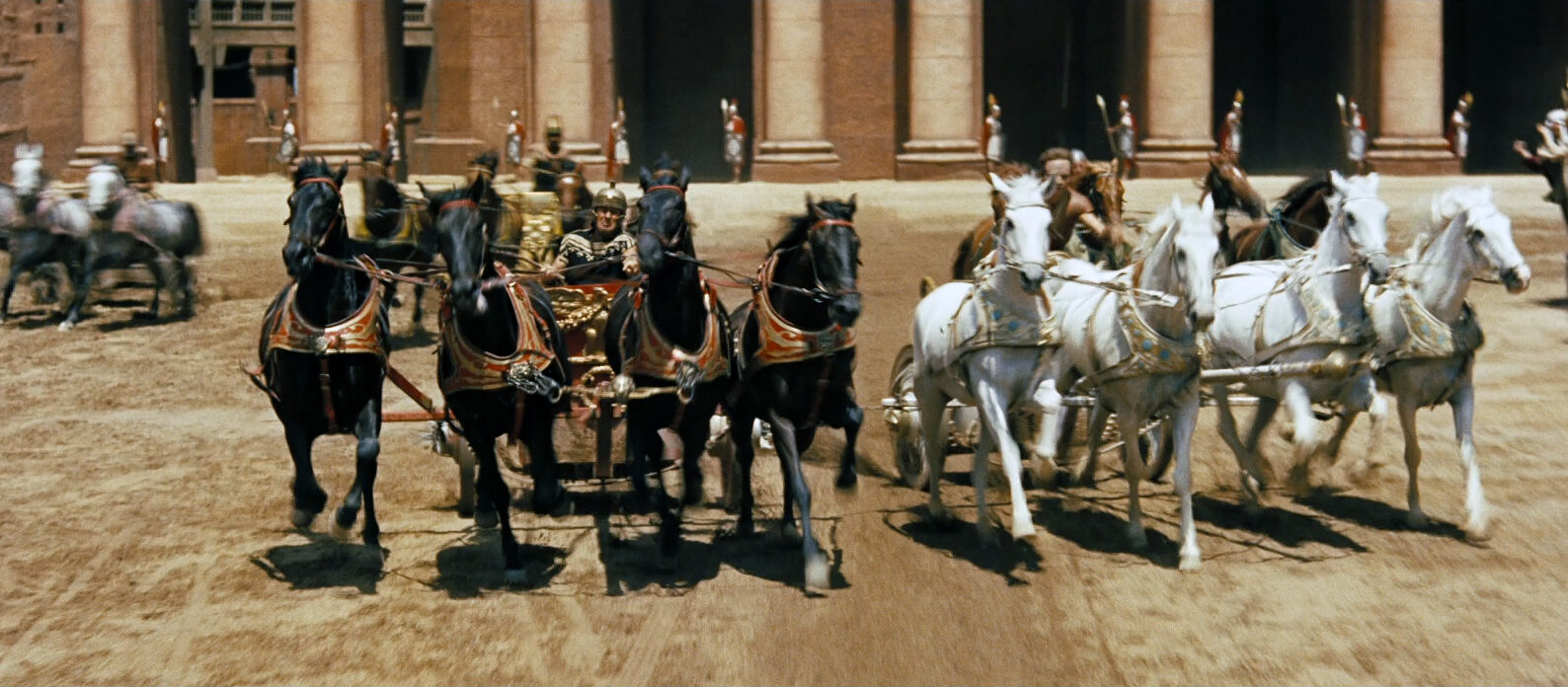
William Wyler’s 1959 Ben-Hur, adapted from Lew Wallace’s 1880 novel Ben-Hur: A Tale of the Christ, neatly sidesteps this problem by building a completely fictional, biblically-themed historical epic that rollicks along as Christ’s life and ministry unfold on the periphery, an uncredited actor appearing a number of times without showing his face or speaking. These tangential path-crossings serve to orient the film’s main narrative, which concerns a Jewish prince (Charlton Heston) who suffers a horrid injustice at the hands of his childhood friend (Stephen Boyd), a Roman tribune with political aspirations.
It’s a classic tale of revenge refracted through a distinctly Christian lens which foregrounds themes of suffering, forgiveness, redemption, and divine providence as it smoothly moves between the intimate and the epic. It’s not spiritually profound, but its wide-reaching melodrama is well-paced for its nearly four-hour runtime, and its magisterial location shoot, cast of thousands, and brilliantly choreographed chariot race remain breathtaking. It’s one of Hollywood’s best big spectacle responses to the rise of small screen entertainment.