“Lost causes are the only ones worth fighting for. And the taxpayer’s cause is about as lost as they come.”
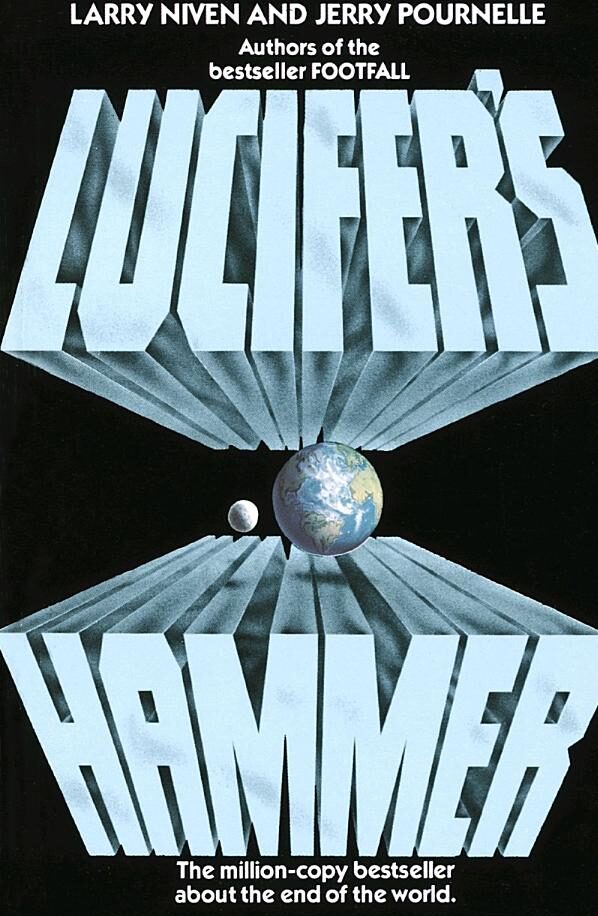
Larry Niven and Jerry Pournelle take a hard sci-fi approach to the end of the world as we know it in Lucifer’s Hammer, a weighty tome about a comet striking the earth and the brutal struggle to prevent the ensuing chaos from setting civilization back hundreds if not thousands of years. Beginning with the discovery of the comet by an independently wealthy amateur astronomer, it quickly establishes a substantial roster of dramatis personae (it actually includes a list in the beginning of the book) including U.S. Senators, documentary filmmakers, nuclear power plant directors, astronauts, boy scouts, astrophysicists, mail couriers, political aides, sex offenders, bankers, ranchers, street preachers, bikers, socialites, secretaries, policemen, hippies, surfers, militant black nationalists. It putters around for the first three hundred pages or so, as space missions are greenlit and survivalists stock up on supplies, but gets really exciting once impact occurs—tidal waves wipe out entire states, fault lines are triggered, volcanoes erupt, foreign powers exchange nuclear attacks, climates change, crops fail, and so on. The authors approach this material with scientific precision in mind, and their knowledge of a wide range of subjects—astronomy, nuclear turbines, radio communications, the power grid, farming, chemistry, medicine, infrastructure—is quite impressive to a reader with some proclivity toward such matters. Having first read the book some fifteen years ago, one chapter that stuck with me vividly involved a character frantically preserving books that might be useful for rebuilding civilization by bagging them with bug spray and mothballs and storing them in a septic tank. They’re less successful in fleshing out the various worldviews that come into conflict in the comet’s aftermath, as they push forward with their science-above-all mantra against pitifully-drawn versions of various religions, women’s lib, black power, environmentalism, counterculturalism, etc. On the one hand, it remains a treat for nerds who actually get a thrill out of engineering-minded characters scuba-diving into sunken cities to retrieve the materials to make mustard gas bombs to fend off hordes of cannibalistic cultists threatening to take over the rural stronghold our main players have established. On the other hand, it remains philosophically lightweight once it strays beyond the authors’ areas of expertise and research, with only about half of its sociological observations ringing true. Its main argument, however—that civilization is fragile—remains fundamentally accurate.