“It’s not all about the Dust Bowl and Johnny Appleseed anymore.”
There’s a pretty high floor for a well-produced ‘60s period piece soundtracked by early-career Bob Dylan covers. Doubly so when it’s a biopic of the mercurial musician’s rise to folk stardom and his controversial crossover to rock ‘n’ roll—a legendary arc of music history rich with memorable scenes and scenarios: hitchhiking to NYC, visiting an ailing Woody Guthrie (Scoot McNairy), mythologizing his past, dating Suze Rotolo (Elle Fanning; renamed Sylvie for the film), cutting a poor-selling album of covers, pursuing his own artistic muse, learning and stealing from every musician he could get his ears on, and finally blowing the doors off popular music by embracing and integrating several heretofore distinct styles of music.
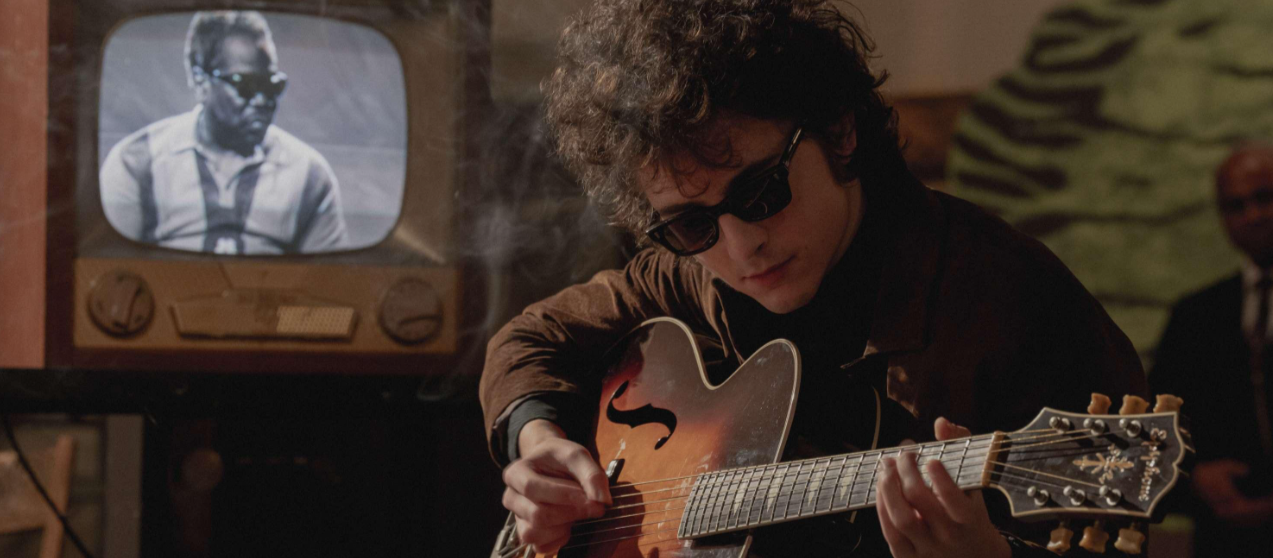
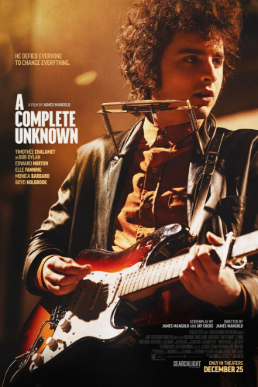
That is to say, I had a fun time watching James Mangold’s A Complete Unknown and thought Timothée Chalamet did a bang-up job with his imitation. The fingerpicking and singing even passed the sniff test—not only from Chalamet but from Edward Norton, Monica Barbaro, and Boyd Holbrook, who respectively portray Pete Seeger, Joan Baez, and Johnny Cash. And it was especially fun as a Dylan fan (though quite less passionate than the legions of uber-obsessives who know all the lyrics and can rattle of the lengthy list of traditional songs he’s covered in concert over the last sixty-some years) to watch it with a non-Dylan fan, nodding, shaking, or shrugging along when asked if I knew this or that song or if a specific scene actually happened the way it did in the movie. (Pretty sure Dylan and Joan Baez weren’t canoodling during the Cuban Missile Crisis.)
Alas, the general challenge with biopics is to create something that is more than just a drip-feed of trivia and unfortunately that is too often the outcome of Mangold and Jay Cocks’s screenplay (based on Elijah Wald’s Dylan Goes Electric!). A procession of radio broadcasts, television news clips, and newspaper headlines keep us oriented on the timeline and color the political backdrop against which Dylan was composing his socially conscious hit songs, and there’s a thin throughline of making oneself vs. finding oneself, of shedding those who wish to box us in, but we are frequently caught off guard by awkward narrative jumps that only feel natural if you already know the story and can quickly process the context of the new scene. We are also treated to narratively superfluous inclusions because how could you not include little Easter eggs like Al Kooper’s (Charlie Tahan) organ playing or cameos from Maria Mulduar (Kayli Carter), Dave Van Ronk (Joe Tippett), and Odetta (who is called out by name in the dialogue and appears on screen but apparently is not credited)? Most strange is that for all its creative liberties, including shifting the infamous Judas incident up a year to have it occur at the 1965 Newport Folk Festival where he first “went electric,” and a script rampant with profanities, Dylan’s response to being called Judas by a disgruntled fan leaves out a crucial word. “Play it loud!” Chalamet calls to his band; Dylan added a sentence enhancer.
At least it’s not whitewashed, portraying Dylan as a diligent songsmith and obvious genius with outsider charisma but also a man of grave moral flaws with an evident lack of care for the individual people in his life and a tendency to view his relationships as transactional. But neither does it offer any formal or intellectual challenges, nor have much of a barb to hook a curious neophyte. It fails to interrogate the idea that Dylan can be a wretched man and also create music that is beautiful and pure; that a man who is “a bit of an asshole” could be the voice of a generation. All that said, I can only complain so much about a competently made film that features a couple dozen diegetic Bob Dylan tunes.