“I’ve got everybody’s blood.”
So thoroughly is Wes Anderson entrenched in his visual and comedic styles that disliking them would essentially prohibit someone from liking his films at all. I find his flippant, twee aesthetic to be enjoyable—if an acquired taste—and it is what Anderson does within the bounds of his house style that ultimately makes or breaks an individual film. To wit, I found The French Dispatch (2021) to be fairly dreadful in its affected sophistications; The Phoenician Scheme, on the other hand, was rather pleasant. Still shallow, dramatically skimpy, and ultimately meaningless, but veering much closer to flipping that script than most of his other work.
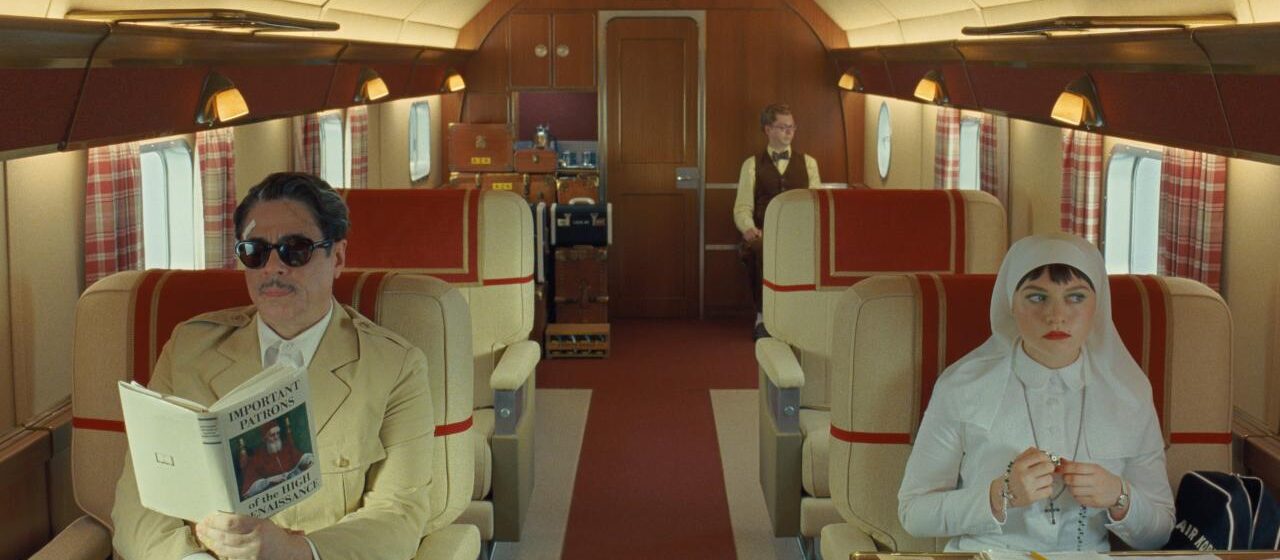
Like many auteurs, Anderson tends to collaborate with the same actors over and over—Bill Murray, Jason Schwartzman, Owen Wilson, Edward Norton, Willem Dafoe, Bob Balaban. The French Dispatch was Del Toro’s first turn with the director; here he gets upgraded to leading man, playing Zsa-zsa Korda, an unscrupulous, charismatic arms dealer, operating in the 1950s, who spends the entirety of the film fending off assassination attempts and conspiracies to disrupt his business empire while trying to reconnect with his estranged daughter (Mia Threapleton), a novice nun who might be persuaded to forgo her vows and assume responsibilities in the family business—if she can be convinced that her father didn’t murder her mother and that she can steer her father’s vast wealth toward the good of all mankind. What follows is a succession of perfunctory fundraising efforts for an ambitious engineering project that serve only to set up Anderson and cowriter Roman Coppola’s desired shenanigans.
Del Toro is a fine actor, indispensable to films like The Usual Suspects (1995), Traffic (2000), 21 Grams (2003), and Sicario (2015). And he is terrific as the world-weary tycoon who feels relatively safe when his personal tutor Bjørn (Michael Cera) finds a bomb on the plane mid-flight because there are 18 minutes left on the timer and the plane lands in ten. In this mode, one sees the extrapolation from his turn as a homicidal genius painter in The French Dispatch, which fits snugly within the actor’s wheelhouse. But The Phoenician Scheme requires Del Toro to contort himself into the patented Wes Anderson archetype of deadpan, motormouthed frivolity that eventually morphs into half-hearted sincerity. This doesn’t play to Del Toro’s strengths and makes the emotional moments feel a little strained and hollow, which of course does a Wes Anderson film no favors.
Several of the Anderson stable flesh out the ranks, among them Dafoe, Murray, F. Murray Abraham, Mathieu Amalric, Bryan Cranston, Scarlett Johansson, and Jeffrey Wright, but it is newcomers Threapleton and Cera who shoulder most of the load. As the religious daughter, Threapleton proves a sure fit to the Anderson milieu; her deadpan delivery matching her stoic detachment from this earthly life but slowly making room for minor worldly pleasures as the film plays out. Cera, who is so natural a fit that one wonders why he was never in an Anderson picture until now, gives one of the funniest caricatures this side of Nacho Libre (2005). His accent is so thick and goofy that he becomes a walking gag—and then reveals that his character is, indeed, faking the whole thing! Laughs—or at least smiles—are also derived from a game of H-O-R-S-E between Korda, the Prince of Phoenicia (Riz Ahmed), and two skeptical Korda investors (Cranston, Hanks), as well as Korda’s penchant for gifting people hand grenades. And then Benedict Cumberbatch shows up with the most ridiculous eyebrows you’ve ever seen.
The Phoenician Scheme is Anderson’s most overtly religious film, merely by virtue of how often it’s right there on the screen and in the script. During his near-death experiences, Korda frequently has visions of the afterlife (Murray plays God), there is discussion of slavery and sin and atheism, and the term “biblical” gets a workout. But it’s mostly for show. If there is a moral to the story it is the value of family, with both Korda and his daughter undergoing changes of heart after spending time getting to know one another. In the end, they both commit to being sincere in their actions, dropping their façades and living plainly. This is what the whole movie has been pointing at with its repetitious dialogue. That’s all well and good but, despite its explicit evocations, the film is much less spiritually engaging than many of Anderson’s non-religious films like Rushmore (1998), The Life Aquatic with Steve Zissou (2004), and The Grand Budapest Hotel (2014), which all dwell upon religious themes beneath their secular surfaces. In the end, it belongs to that crop of Anderson films in which the filmmaker’s own cleverness overwhelms any skerrick of humanity that might have ended up on the screen. As a forgettable romp, it’s fine enough, and less actively irritating than The Royal Tenenbaums (2001), Fantastic Mr. Fox (2009), Asteroid City (2023), et cetera, but I doubt The Phoenician Scheme is bound to become the favorite of any Wes Anderson fan of whatever stripe.