
“I told you chuckleheads that story was never gonna work.”
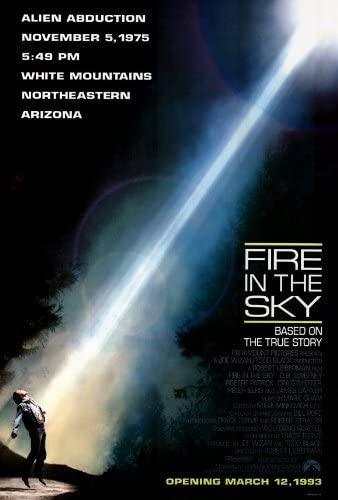
Although it boasts a riveting alien encounter, there isn’t much else to note about Robert Leiberman’s Fire in the Sky. To make matters worse, that scene doesn’t arrive until late in the film and it is over nearly as soon as it begins. Based on the “true” story of Travis Walton’s (D.B. Sweeney) disappearance while logging a forest in 1975,1 the film mostly follows Walton’s fellow crew members as they report his disappearance and subsequently face the criminal investigation and gossiping townsfolk who struggle to believe the outlandish story they tell.
The film opens with a quote from the Stoic philosopher Seneca, then introduces us to a logging crew as they arrive shell shocked at a bar, ignoring everyone and gathering around a table. Soon their leader, Mike (Robert Patrick) uses a payphone to report the disappearance. Investigator Frank Waters (James Garner) arrives and begins questioning the young men, singling out one in particular who was not fond of the missing Travis.
Through periodic flashbacks we see the friendship between Mike and Travis, Travis’s romantic involvement with Mike’s sister, their financial struggles and their plans for the future. The overview takes us up to the recent past as they set out to do some contract work clearing brush in the state forest. During their trip back in the dark, they see a strange light in the woods. At first, they think it may be a crashed plane, or a forest fire; but as they approach the truck’s radio stops working, and they see that the light is emanating from a strange vessel hovering in a clearing. Travis immediately gets out of the truck and approaches the hovering craft with open arms and a smile. His friends protest, but he continues walking towards the ship. He stares up into the light, transfixed, and is suddenly lifted off his feet by an invisible force.
The others quickly flee in the truck. Mike drops the others off on a main road and then returns alone to search for his friend—to no avail. They send out search parties, but the media makes their story into a sort of joke, and the community believes that one of the other men killed Travis. The rest of the story is largely formulaic and uninteresting. Replace the UFO with a missing-person case or a suspected murder and almost nothing about the investigation changes. The actors do what they can with the material, and there is some solid shot composition and set pieces, but the story of the crew simply isn’t very compelling when one of the other characters was abducted by aliens.
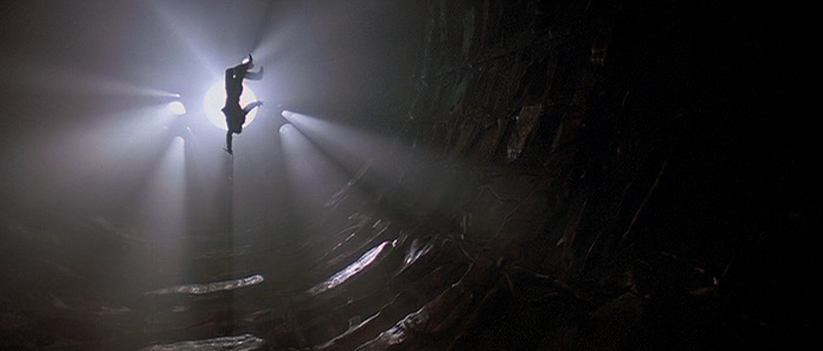
When Travis is finally found, he is naked, afraid, and excitable. At a kind of homecoming party, something triggers his memory and he relives his time in the alien ship. If the alien abduction sequence didn’t exist, the rest of the movie hardly be worth tracking down (and it still might not be, because you can find the interesting parts online pretty easily). But this is a legitimately frightening concept and execution of an alien encounter, and is so different than the rest of the film that it is almost as if a different director handled this portion of filming. The alien vessel doesn’t appear as some Trekkie’s wet dream; it actually looks like something alien. And the extraterrestrials are malevolent, or at least unaware that invasively experimenting on a human isn’t likely to be agreeable for the test subject.
The special effects for this scene were handled by Industrial Light & Magic, the same studio responsible for everything from Raiders of the Lost Ark (1981) and Jurassic Park (1993) to Mishima: A Life in Four Chapters (1985) and Dreams (1990). It is worth browsing through their filmography to see the vast impact that the studio has had on modern film. In any case, the effects here are outstanding, but the scene which features the them is only a blip towards the end of the film.

Since Fire in the Sky is based on a true story, and the brief encounter is all that Travis remembers, I suppose I can’t really ask for more. While the scene in the alien vessel is a great bit of science fiction weirdness, it simply doesn’t offer enough to carry an entire feature. This prevents the stellar UFO sequence from bearing mention in the same breath as cornerstone alien encounter fiction like Close Encounters of the Third Kind (1977), Contact (1997), or The X-Files (1993–2002, 2016–2018), and situates it alongside fellow low budget “true” abduction film Communion (1989). It would have made a great short film, but without the context it would have appeared as pure science fiction, which is not the intent of this film. It even includes postscript telling us that the crew members—including Travis—passed a lie detector test more than a decade later (in addition to the one shown in the film). Even with the postulation of the truth of the story, there simply isn’t enough to sink your teeth into to make this worthwhile. Don’t feel guilty for just looking up the most interesting bits online.
1. A documentary about the incident was released in 2015 called Travis: The True Story of Travis Walton.