
“Have the monks stopped meditating? Have they stopped praying? They all seem to be tweeting.”
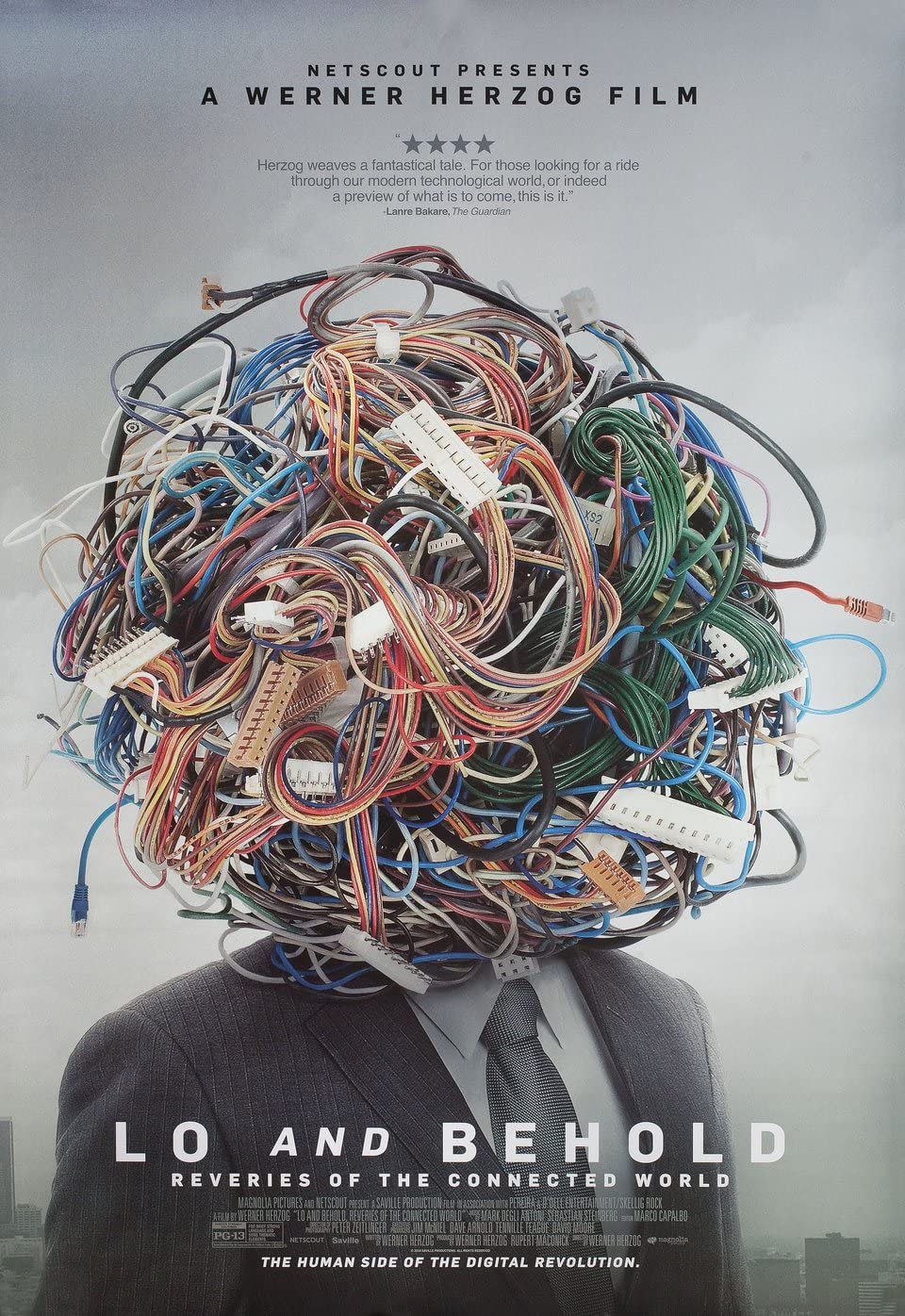
In Lo and Behold, subtitled “Reveries of the Connected World,” Werner Herzog turns his curious layman’s eye toward the digital ecosystem, beginning with the advent of the internet and tracing its impact forward through robotics, artificial intelligence, self-driving cars, video games, the Internet of Things, and what forms it may take in the future. The film is broken into ten chapters, bearing mystical and ominous titles like “The Glory of the Net,” “The Dark Side,” “Earthly Invaders,” and “The Internet of Me.” Unsurprisingly, from Herzog’s perspective, the eccentric geniuses who create these pervasive technologies are as fascinating as the tools themselves. And so he points his camera at them and allows them to explain the glories and downsides of the web from their insider perspectives, interspersing his own relaxed narration to act as a guide.
It begins with the “birth” of the internet on UCLA’s campus where Leonard Kleinrock, a professor who worked on early communication protocols, shows off the first computer node used for internet communications. It looks like an old fridge but functions now as a kind of sacred shrine to technological innovation. He recounts the first transmission from this computer to the Stanford Research Institute in 1969, where their computer crashed two letters into “login” and thus the first message ever sent via the internet was “lo.” He calls this message “prophetic.” There are similar interviews peppered throughout the film that are by turns interesting, amusing, quirky, and distressing. For instance, I thought it quite funny to learn from Danny Hillis that in the early days, there was a spiral-bound directory of everyone who had an email address; such a directory would now be seventy-two miles thick and fail to attach real-world identities to many users. Later, Sebastian Thrun shows the virtual worlds created in the “mind” of self-driving cars that allow them to operate safely. Joydeep Biswas, a computer scientist at CMU, shows off his team of soccer-playing robots that he hopes will one day compete with the likes of Messi, Ronaldo, and Neymar.

But even as the documentary (which was sponsored by tech company NetScout) reads in part like an extended advertisement for its subjects—or even hagiography—Herzog also sheds light on the myriad drawbacks of these technologies. There’s a story of a Korean couple who neglected their baby to the point of death because they were so invested in a computer game which, ironically, tasked them with nurturing and caring for a child. Herzog interviews several young adults who are living semi-permanently at an internet rehab addiction center; one of the interviewees seems more or less recovered and can dispassionately speak about his former habits while another has to cut her interview short because her identity is still wrapped up in her virtual avatars. After showcasing a gigantic radio telescope that can pick up minute sounds from extremely distant sources in outer space, Herzog profiles several individuals who suffer from electromagnetism sensitivity and thus must live within the no-electronics zone surrounding the telescope. Legendary hacker Kevin Mitnick provides a few anecdotes that highlight enormous security risks, and several astronomers explain how disruptive a large solar flare could be to a society that is so dependent on digital connections. Most alarming, perhaps, is the anonymous cruelty that the Catsouras family faces when gruesome images of their daughter’s lifeless body were circulated online after her fatal car crash. A fascinating tension develops in which it seems like modern society would collapse without the interconnectedness granted by the internet, and yet that very thing is destroying life as we know it.
I have always believed that the internet is a manifestation of the antichrist, of evil itself.
These sharp critiques build on one another nicely and do not outstay their welcome. But then, as soon as you think that Herzog is all in on doom and gloom, his final few chapters take a turn back toward an ambitious future that remains aware of the potential pitfalls that we’ve already stumbled through. Elon Musk is interviewed and offers as many cautionary examples as hopeful ones. There’s even a moment where he sits deep in thought for quite a while before telling Herzog that he never has good dreams, only nightmares. CMU scientists discuss a novel disaster-zone robot that could be deployed in situations deemed too dangerous for humans.

The most ominous notion presented in Lo and Behold is not any of the stories included to shock the viewer. Rather, it bleeds through in the portions that ostensibly look forward with optimism. Consider the interview with Thrun in which he discusses a fleet of self-driving cars that can all learn from one another. For instance, if one car makes a mistake and some code is updated to correct it, all other cars will now have that corrected code; unlike humans who must each learn for themselves. But Thrun slips in a very weird phrase at this point, suggesting that “all future unborn cars” will also avoid that mistake. Later, when describing his team of robotic soccer players, Joydeep Biswas professes “reverence” and “love” for a certain one of his robots. And when we get to discussing the future with cosmologist Lawrence Krauss, he questions whether subsequent generations will need human interaction at all. It is suggested that once AI becomes self-aware that we’ll have to adjust our ideas of theology and morality.
Such discussions call into question the very basis upon which we pursue technological innovation. Certainly, reducing the number of car crashes sounds like a great idea (although even that would have peculiar downsides, such as less organ donors); soccer-playing robots are a great undergrad project. But if we replace all human activity with robots, then we’ll find ourselves in pods of goo, plugged into a virtual reality. Or extinct. Why? Because computers can do things more efficiently than we can? But to what end must we do things more efficiently? Why is efficiency a goal, and not say, human flourishing, beauty, righteousness, and so on? (I was reminded of great EconTalk episode where Russ Roberts interviews astrophysicist Sandra Faber, who thinks that it would be “great” if our “descendants” were machines.) Kleinrock, an innovator in the field, admits near the end of the doc that the internet is “the worst enemy of deep critical thinking.”
I don’t know about you, but I have no desire to watch robots play sports. Give me human athletes who have put in the blood, sweat, and tears to hone their bodies and minds. Even better is if you and I go out and play some pick-up ball ourselves. Despite the documentary’s sponsorship by a tech company, Herzog appears to feel this way too, concluding his film with a live bluegrass performance and a gathering around a campfire.
Ultimately, Lo and Behold does not concern itself with elucidating history, nor does it encompass the entirety of its subject. As with many of his documentaries, Herzog is simply exploring a topic with a camera crew and then loosely stitching his results into a stream-of-consciousness mosaic that is meant to provoke, not teach. It will certainly make you think.