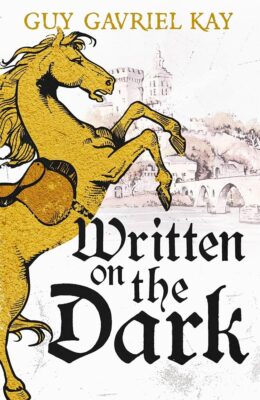
“It seems to me that most moments in a life can be called interludes: following something, preceding something. Carrying us forward, with our needs and nature and desires, as we move through our time.”
Written on the Dark returns readers to the quasi-Renaissance world familiar from The Lions of Al-Rassan (1995), The Last Light of the Sun (2004), and several other unserialized Guy Gavriel Kay novels. The story, slim by Kay’s standards, follows Thierry Villar, a tavern poet from Ferrieres (Kay’s version of France) of no apparent consequence, as shifting politics and private loyalties draw him into the margins of decidedly consequential events, namely, the murder of a duke, an invasion from an island nation, and an impending civil war.
Kay’s customary pleasures are abundant: burnished prose, ruminations on love and life, half-glimpsed puppet strings of power, dignity granted to the least of these, the sense that art and memory are essential and durable forms of defiance. Yet the novel’s structure and proportions are miscalibrated. Some momentous events are breezed through (the Joan of Arc character enters and exits in about thirty pages) and main characters are uncharacteristically underwritten and unmemorable, but there is also, despite the slimness and fast pace, a tendency to dilly-dally on trivial matters before roughly shifting gears.
For long stretches, it reads as a fictional biography—episodic, attentive to Thierry’s personality, interested in how a young poet learns to notice and remember and be liberated through his art. But then it widens out to illuminate the grander turbulence of the realm with its factional rivalries, courtly humiliations, campaigns, conspiracies, et cetera. These passages and all their historical analogs could coalesce to form a rich backdrop for the intimate story (as they do in most Kay novels), but they overbear on Thierry’s perspective, and the two are often in disaccord. The impact of the human-scaled story gets diluted when the sensitive protagonist is pushed into the theatrical melodramas of royal intrigues. Additionally, there’s a weird and offputting embrace of sexual deviancy and crude language for its own sake that add nothing of value and only detract from the storytelling (a similar issue undermined Jonathan Franzen’s Freedom [2010]).
Still, such complaints are made in the presence of much that is lovely. If Kay, a newly minted septuagenarian, is indeed turning elegiac, one can forgive his desire to linger. Even when the personal and the political do not quite harmonize, there remains the abiding conviction that it is in art that we might remember what is left out of official histories, and that this remembering is of crucial importance.