“Keeping track of time around here is pointless.”
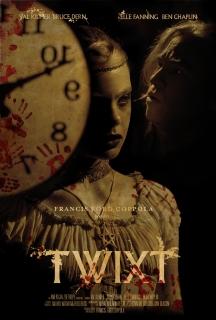
We’ve since seen the release of the long-gestating Megalopolis (2024), but Twixt was the newest Francis Ford Coppola film when I first discovered his larger corpus beyond the obligatory viewings of The Godfather (1972), The Conversation (1974), and Apocalypse Now (1979). While his previous two comeback films, Youth Without Youth (2007) and Tetro (2009), have generally fared better critically and are more complete and polished experiences, I am very fond of this extremely personal and eerie horror film.
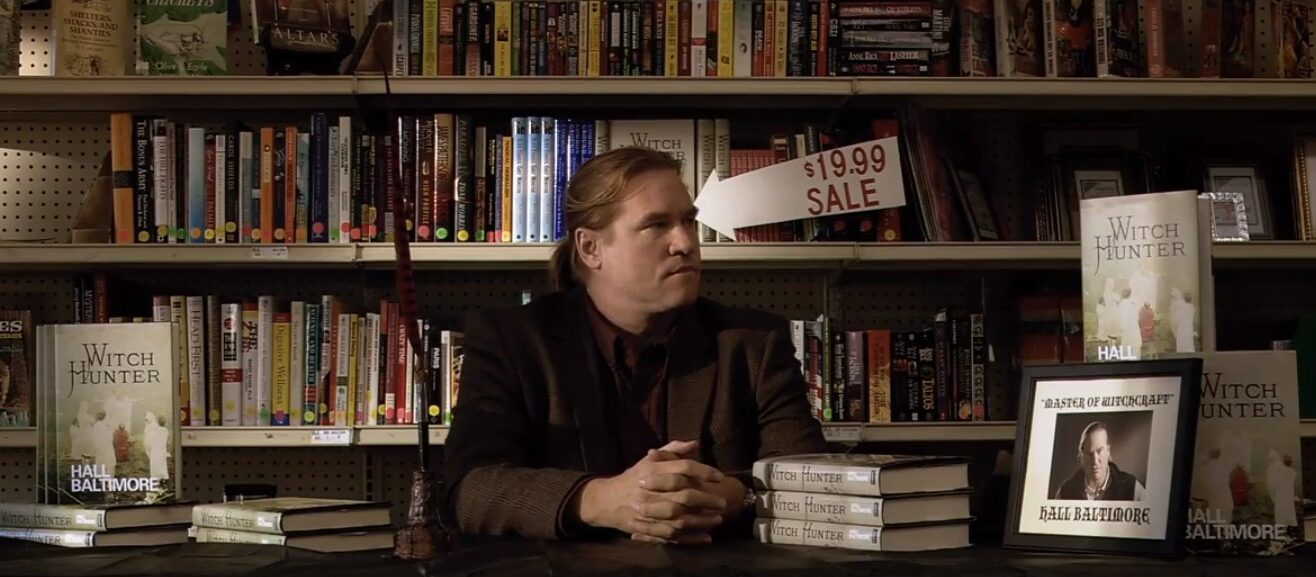
A ponytailed Val Kilmer stars as a “bargain-basement Stephen King” who stumbles across an inspiring real-life murder mystery while on a book tour stop in a boondock so obscure he has to set up in the local hardware store. After an opening narration from Tom Waits sets the stage, Kilmer meets the quirky sheriff (Bruce Dern), who regales him with stories of serial killers and shock massacres and a “doozy he’s got in the morgue,” and informs the writer that the sheriff himself likes to spin horror yarns. He fends off a nasty video call from a wife (Joanne Whalley, Kilmer’s ex-wife, ironically) who doesn’t care about his artistic ambitions and just wants him to write another hack horror novel and win some bread. “People always ask me, ‘How do you know so much about witches?’” he says. “And I tell them, ‘Because I married one!’” That night, he dreams of haunted places and meets a vampire child (Elle Fanning), who begins telling him of the town’s past: a deranged preacher, a seven-sided clock tower inhabited by the devil, a vampire sex camp on the other side of the lake, dead children. He meets the ghost of Edgar Allan Poe (Ben Chaplin), who deepens the mystery and turns his gaze inward. Having struck out finding any other inspiration and desperate for an influx of cash to prevent his wife from selling his rare copy of Walt Whitman’s Leaves of Grass (1855), he agrees to collaborate with the sheriff on a vampire story based on the town’s dark past and pitches the idea to his publisher.
One thing you don’t see noted much—which to me suggests that most people had their grouchy minds made up about Coppola’s return to moviemaking and were eager to dismiss his film—is that when it’s not being all spooky, it’s an undisguised comedy. A lot of this rests on Kilmer’s shoulders and seems potentially improvised. Before caving to the sheriff’s persistent requests to write a story together, he sits in his hotel room with beef jerky and whiskey, pretending he’s Marlon Brando beholding fog on a lake, then a gay basketball player from the ‘60s. “Do I like short shorts? They’re revealing but they’re comfortable. It helps me jump.”
The film doesn’t gradually transform from an offbeat horror story to a ghostly tale of dead children, but rather bounces around between the two modes as Kilmer straddles the line between the waking and dreaming worlds. This leads to some tonal whiplash as we jump from Kilmer antics to flamboyant vampires (Alden Ehrenreich) to ineffably beautiful combinations of image and sound that are uncertainly moored to the reality of the film. Cinematographer Mihai Malaimare Jr. does some very interesting work with muted color palettes accented with a few bold colors, almost in the vein of Sin City (2005).
One would not expect outright schlock from Coppola. He doesn’t get down and dirty like Stuart Gordon or Larry Cohen, but rather tempers his nastiness with a sense of the uncanny. It’s elegant and tasteful, wrapped up in Coppola’s sophisticated understanding of how integral art is to our own conceptions of ourselves, our family, and our culture. But when Coppola is ready to be brutal and splashy, he proves eminently capable. Mostly, though, this is a surreal odyssey through memory and fiction not unlike Twin Peaks (1990–1991) or Abel Ferrara’s Siberia (2020), centering on a clueless mystery, a potentially victimless crime, and a slew of red herrings.
Following his commitment to self-fund films based on original stories with a personal element, Coppola financed Twixt for $7 million based on his own nightmare and used the filmmaking enterprise to artistically work through the death of his son in a speedboating accident in the ‘80s (eerily restaged in the film). Not to mention that Kilmer’s has-been writer trying to find the spark again is essentially what Coppola himself was doing with his film. Most critics took jabs when evidence of its “low budget” (read: digital cameras and cheap CGI) appeared on screen and used that as justification to ravage the film. Methinks they just couldn’t hang with the artistic blurriness of the whole endeavor and found an easy way to dismiss it. Coppola had spent a good long while being a hired gun to pay off his debts stemming from the colossal failure of One from the Heart (1982). If green screen and digital photography free the man from the strictures of big studios, I want to watch the films of the free man, even if he’s something of an impassioned daredevil.