“I feel good, I feel great, I feel wonderful.”
Bill Murray has been a comedy all-star for a very long time. Consider his numerous high profile starring vehicles (Ghostbusters [1984], Groundhog Day [1993], Stripes [1981]) and his bountiful supporting roles (Caddyshack [1980], Wild Things [1998], Ed Wood [1994]), not to mention his memorable cameos (Space Jam [1996], Zombieland [2009]). I mean, you’ve at least heard that all of those movies are good-to-great, even if you haven’t seen them, right? And that’s not even touching on his more dramatic roles like those in Lost in Translation (2003) and Broken Flowers (2005) or all of those films he has made with Wes Anderson. Taking all that into account, it’s understandable that a few gems might fall through the cracks of the popular consciousness.
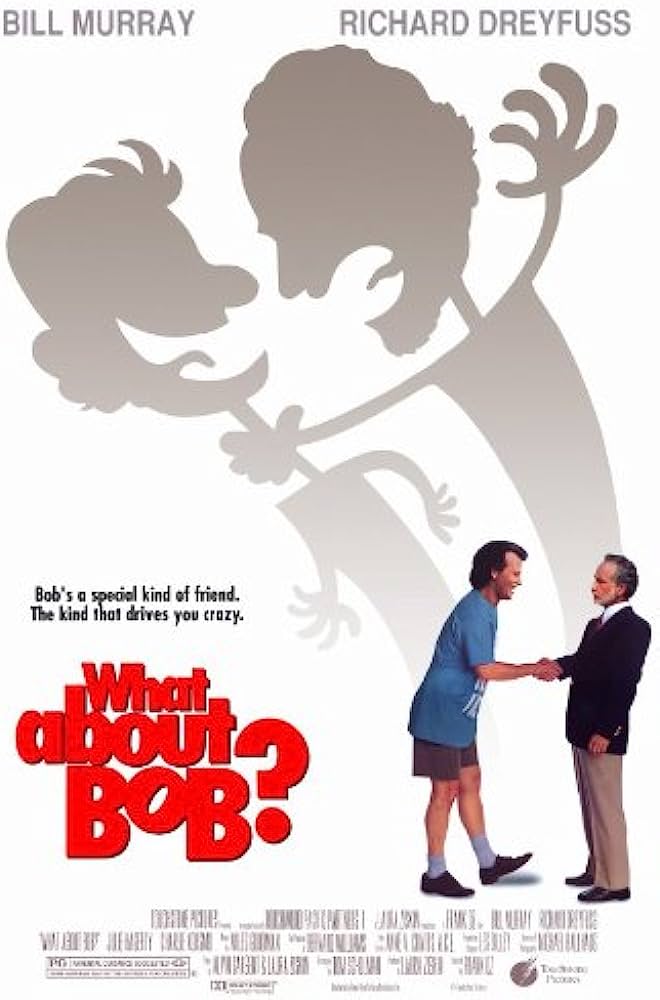
Case in point: What About Bob?, a tremendously gut-busting black comedy that is somehow also (for the most part) family friendly. It follows a mentally unstable patient named Bob (Murray) who follows his egomaniacal psychiatrist Dr. Leo Marvin (Richard Dreyfuss) on his family vacation because he doesn’t think he can survive a month without therapy. Everyone except the extremely longsuffering Dr. M. (who is surely the film’s most empathetic character) seems to love Bob—the doctor’s wife (Julie Hagerty), his children (Charlie Korsmo, Kathryn Erbe), the cantankerous old couple who run a local coffee shop (Tom Aldredge, Susan Willis), the director (Doris Belack) and staff at the asylum that refuses to commit him—but only because he took the psychiatrist’s initial advice (“baby steps”—incidentally the title of his new best-selling book) and ran with it.
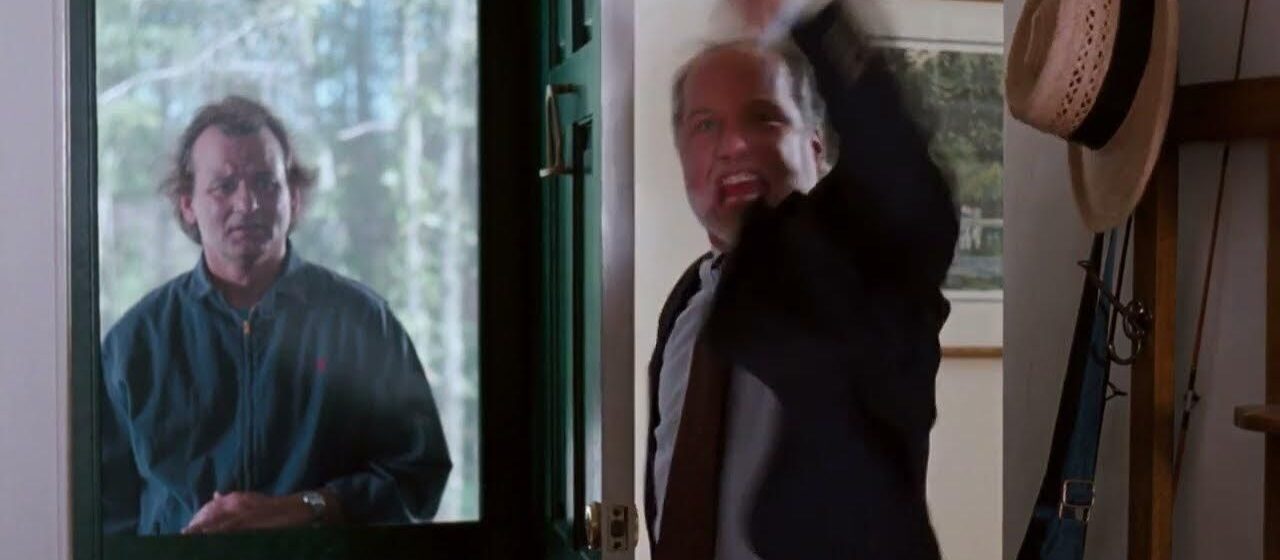
And so, as the world opens up for Bob, it comes crashing down around Dr. Marvin, with comedic touches coming from every direction, not just Murray’s lovable schtick. While the highlights are in ample supply and keep the laughs coming even on an umpteenth rewatch, my favorite scene comes when Dr. Marvin throws Bob out of his lakeside vacation home with an explosive diatribe. “You’ve ruined my life! You’ve ruined my career! You’ve ruined my book! You’ve turned a perfectly peaceful house into an insane asylum. Get out!” His family is dismayed, and his son asks why he had to kick Bob out of the house. “You think he’s gone?” he retorts. “He’s not gone. That’s the whole point! He’s never gone.” With that he throws the front door open, without even looking to confirm his suspicion. There’s Bob. “Is this some radical new therapy?” he asks.
Of course, that moment is rivaled by a rejoinder so delightful that the actor who delivers it (Korsmo) struggles to deliver it without laughing. “I want some peace and quiet,” Dr. Marvin says, when he discovers his son and his patient jumping on the bed and shouting profanities as they mimic someone with Tourette syndrome. “Well, I’ll be quiet,” Murray says. Korsmo holds up his first two fingers to form the universal sign. “I’ll be peace,” he says.
The screenplay (Tom Schulman) and direction (Frank Oz) delicately balance farcical comedy with hints of deeper themes, but it’s Dreyfuss and Murray (who apparently butted heads while on set) and their superlative supporting cast that lift What About Bob? into that small collection of comedy films that you love to know like the back of your hand.