
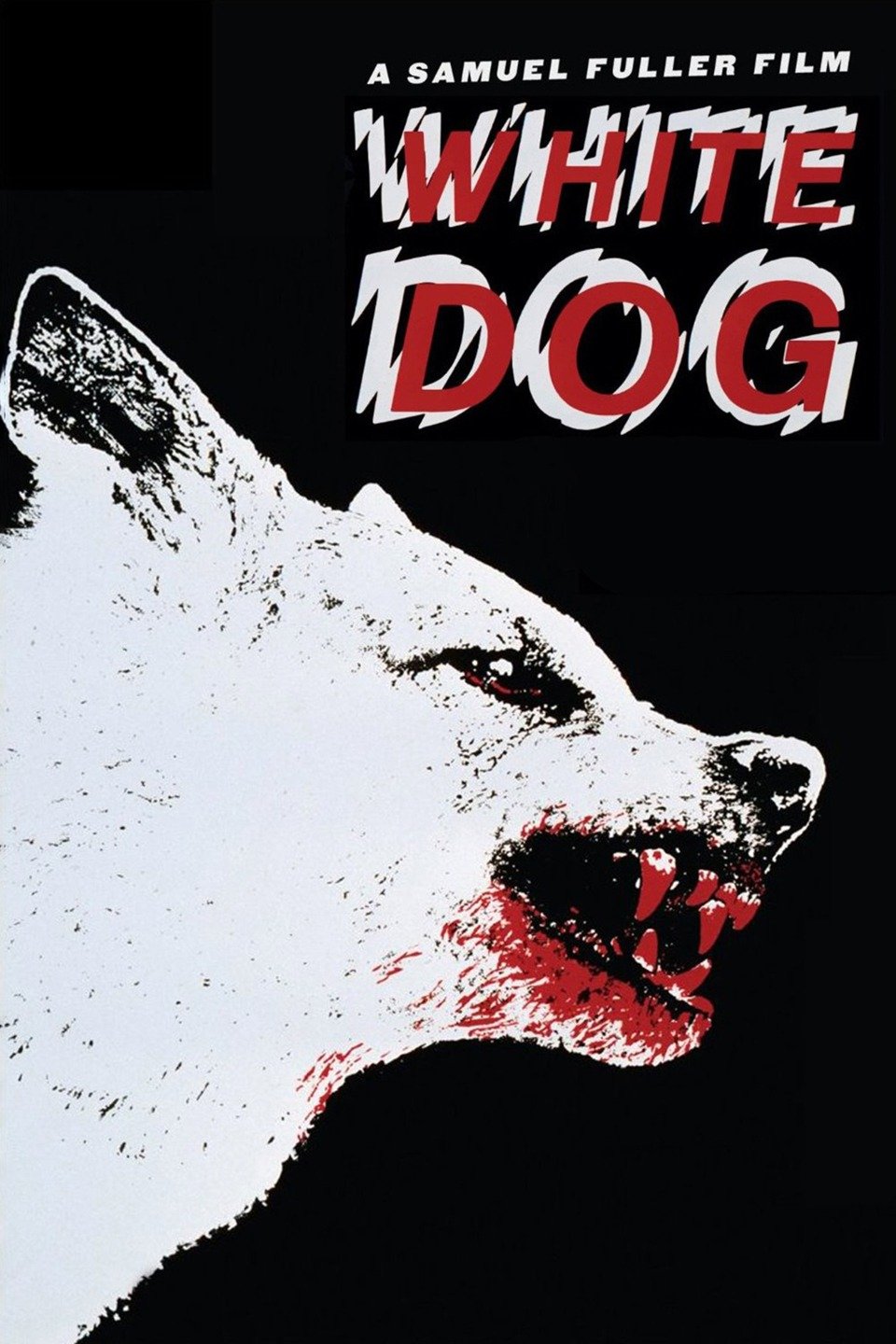
“You got a four-legged time bomb!”
Is racism a learned behavior? If so, can it be unlearned once it’s been deeply ingrained? If the answer to either question is no, should the racist be punished? White Dog, a late entry in Samuel Fuller’s oeuvre, explores these questions with only a single degree of separation from its subject matter by making its bigoted serial killer a canine instead of a skinhead. The film is based on an autobiographical novel by Roman Gary (who, once upon a time, challenged Clint Eastwood to a duel for sexing his wife, Jean Seberg of Breathless fame—ah, the rabbit holes of Wikipedia). Even in the hands of a provocateur like Fuller such material could be handled in a number of different ways—he elects to shoot it as a lurid melodrama, tinged with horror and exploitation, utterly unsophisticated on the level of its plot but marked by an eclectic sense of film style.
An actress (Kristy McNichol) on the margins of Hollywood runs over a stray dog and then nurses him back to health. Initially she tries to locate the owner but when the dog protects her from a serial rapist she finds herself bonding with a loyal pal. Only, as she will soon realize, Mr. Hyde is a “white dog” that has been trained to hunt and kill African Americans. Despite continued carnage, a brave, black, showbiz menagerie trainer (Paul Winfield) commits to curing the dog of his prejudice, which he does, only for the spectral beast to turn around and kill the trainer’s partner (Burl Ives), a white man. We never see any racial violence in the film at all; only the secondhand savagery delivered by the animal which at times takes on the aspect of an elemental force or the embodiment of mankind’s depravity rather than acting as a mere stand-in for a human xenophobe. As Jonathan Rosenbaum pointed out when the film saw a brief theatrical release in 1991, the German Shepherd of White Dog is similar to the donkey in Robert Bresson’s Au Hasard Balthazar, a mute beast, ultimately dependent, that reflects the best and worst of humanity while remaining entirely distinct from us—loyal yet unpredictable, tender yet ferocious.

Because Fuller was neglected during his lifetime but heavily influential on several filmmakers who have retroactively touted his work, there’s a tendency to overcorrect, setting unrealistic expectations for a director who marched to the beat of his own drum. Fuller’s works weren’t necessarily misunderstood (even if this particular one was suppressed and largely unavailable until Criterion’s home release in 2008). They were and are difficult to parse and don’t always sit well. What exactly is the message of White Dog? That black people should tirelessly strive to rid the world of unwarranted animus directed toward their race? And wait, why does the hound of death seem like a sympathetic character here? Why shouldn’t we side with the throng of people—which grows larger with each fresh “Jaws with paws” kill and is comprised primarily of white people—that thinks the mutt should be turned into fish food? What does it mean when Mr. Hyde escapes the training grounds, stalks a black man into a church, and then gazes up at a stained glass window of St. Francis of Assissi from the bloody aftermath? Is reconditioning itself a form of violence?
This is no elegant treatise on the subject. And yet it is that very same lack of outright palatability—all those made-for-TV markers and unconventional camera moves and obscure guiding moral principles and Ennio Morricone’s tantalizing score—that makes it so interesting. It’s both amusing and discomforting to look back at a film so clearly made by someone seeking to address ugly racial tensions that was initially perceived as racist on its own terms and would probably still be considered racist by the majority of vacuum-skulls who would get hung up on the premise and vaguely exploitative presentation. It’s a coagulated concoction, to be sure, but it must be commended for its boldness. As usual, Fuller’s cinematic instincts subsume his pedagogy.