
“Sincerity belongs to people who have known sorrow.”
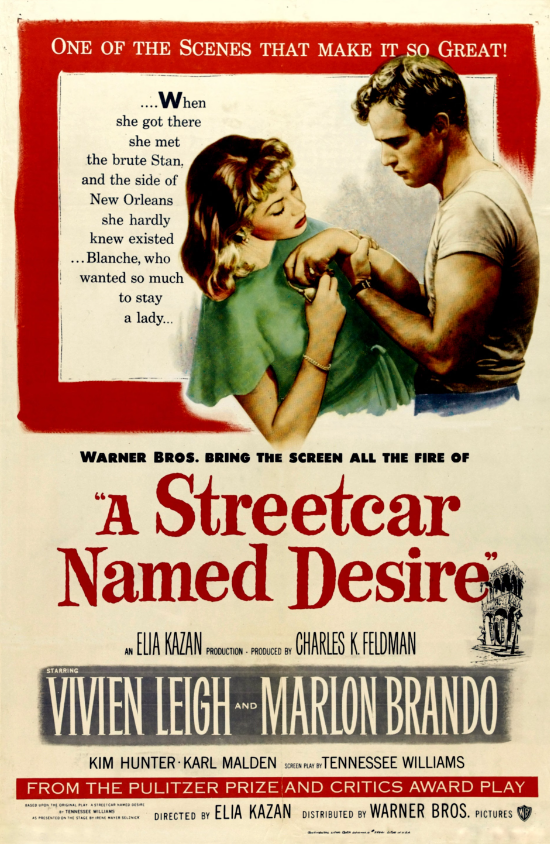
Even after decades of performances, nay careers, that owe their existence to Marlon Brando, the method actor’s show-stopping turn as Stanley Kowalski in A Streetcar Named Desire remains essential.
Following director Elia Kazan and several co-stars from the stage to the screen with a slightly censored version of Tennessee Williams’ seedy scenario of a tragic Southern Belle (Vivian Leigh) moving into a cramped New Orleans apartment with her sister (Kim Hunter) and brother-in-law (Brando), Brando exhibits an animal ferocity and a sweaty authenticity that would fundamentally change the acting profession. He chews gum, scratches, mumbles, bellows. His raw display of ugly emotions, and his constant improvisatory roving, prominently stand out from the mannered film around him, reinforcing the notion that Stanley is the catalyst for the heightened chaos that ensues.
Though he is not quite matched by Vivian Leigh, who employs a classical approach, her sense of fragility and neurotic instability are crucial to the film’s drama and won her an Oscar (Brando lost to Humphrey Bogart’s performance in The African Queen). Indeed, the mismatch between her aristocratic persona and Brando’s temperamentality is a key ingredient, as her coquettish talk is reciprocated only by Stanley’s poker buddy Mitch (Karl Malden), a development that compounds the tension between the in-laws and eventually brings it to a shocking climax.
Under a constant barrage of harsh streetlights, humid afternoons, and low-stakes poker games, an intense tragedy unfolds that doesn’t quite achieve the pathos one might expect from the premise and the author, but which provides an adequate platform for the film’s terrific performances.