
“A stripper gettin’ dressed ain’t beautiful unless she’s ugly to begin with.”
Years before The Simpsons came along and definitively proved that cartoons could qualify as mainstream entertainment for adults, provocateur Ralph Bakshi was out there making X-rated animated films like Fritz the Cat Coonskin that pushed buttons and dealt with mature themes. But for American Pop the filmmaker eschewed his sleazier tendencies in favor of a more ambitious and expansive and personal aim—an audiovisual survey of a century of American pop culture evolution, a thorough squeezing out of a creative sponge that had been soaked in Americana ever since the filmmaker’s own family moved to the United States when he was a child.
Using a frame story that follows five successive generations of a family of musically-aspirational Jewish immigrants, from turn-of-the-century Russia through 1970s America, the film begins in the style of a silent film (complete with title cards) before moving through burlesque theater, vaudeville, jazz, blues, psychedelia, and rock ‘n’ roll, with many iconic figures either represented in their own likeness or as fictionalized stand-ins or on the delectable soundtrack. This musical odyssey is undergirded by strands of the broader culture—the Second Industrial Revolution, World War I and II, mobsters, beatniks, greasers, Vietnam, sexual liberation, drug abuse, poverty.
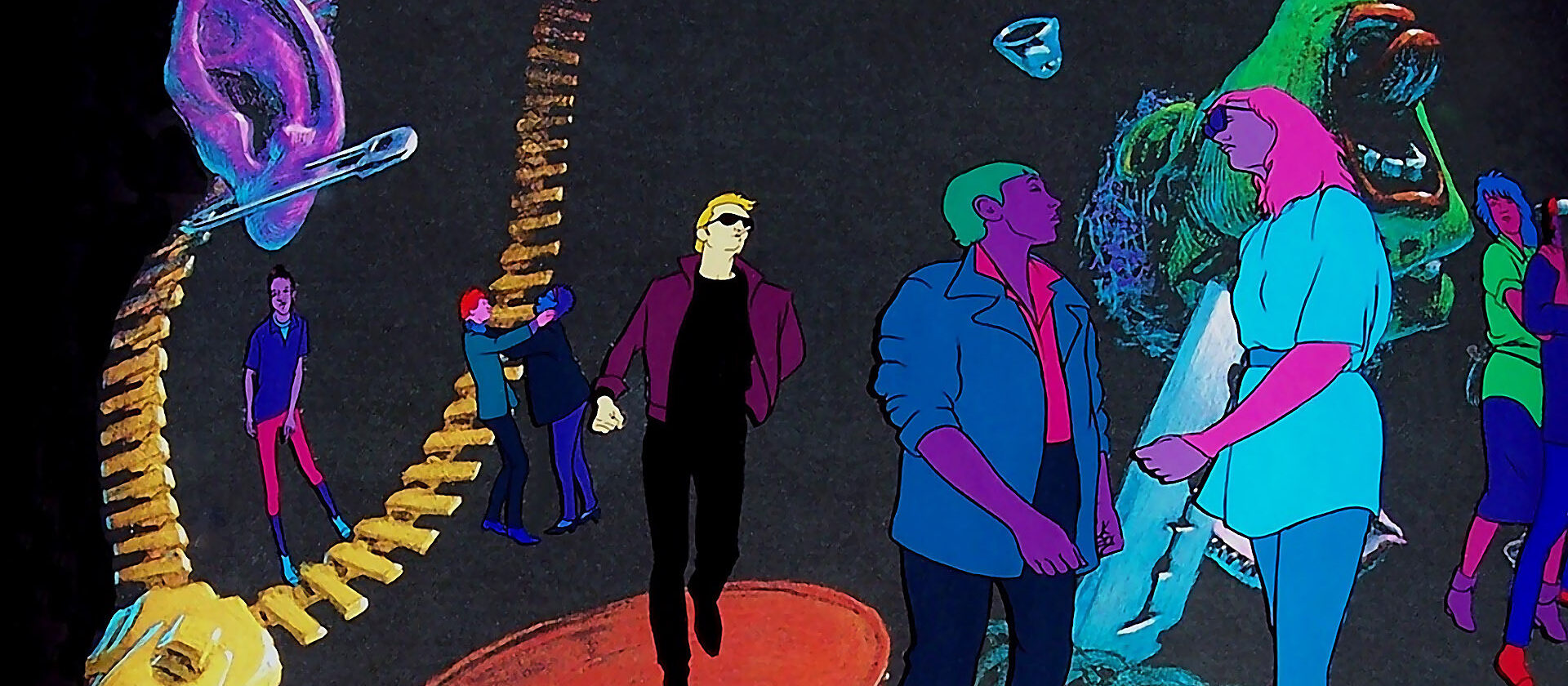
Bakshi hurtles headlong through this miniature epic, manically jumping between his signature rotoscope animation style (working better here in this unreal compression of history than it does in other films), water-color stills, psychedelic collages, live-action shots, computer graphics, and archival newsreel footage.
Its heady swirl of themes—of intergenerational connection, of art’s pollination of history and of the human experience—might be most clearly illustrated when Benny (Richard Singer), the second of our four protagonists, the son of a stripper who was killed by a mail bomb intended for his criminal father, finds an abandoned piano in a bombed-out house in Nazi Germany and lays his gun down to play. After he concludes, a German soldier who had come upon him and enjoyed his enraptured performance thanks him and then riddles his torso with a machine gun. Or maybe it’s when Benny’s grandson Pete (Ron Thompson), a cocaine dealer for all the big musical acts, threatens to halt the supply if he isn’t given the chance to record a studio demo, parlaying the opportunity into a chance to front his own rock band (although, how Bob Seger’s ‘Night Moves’ is anyone’s—read: a lame studio exec’s—idea of punk is beyond me).
American Pop can be viewed as a tragedy, but Bakshi’s subtle humanism wins out, I think, in the way he describes the deep bonds born from a shared love of music—a mutual passion that forms connective tissue and helps the downtrodden make it through another day.