
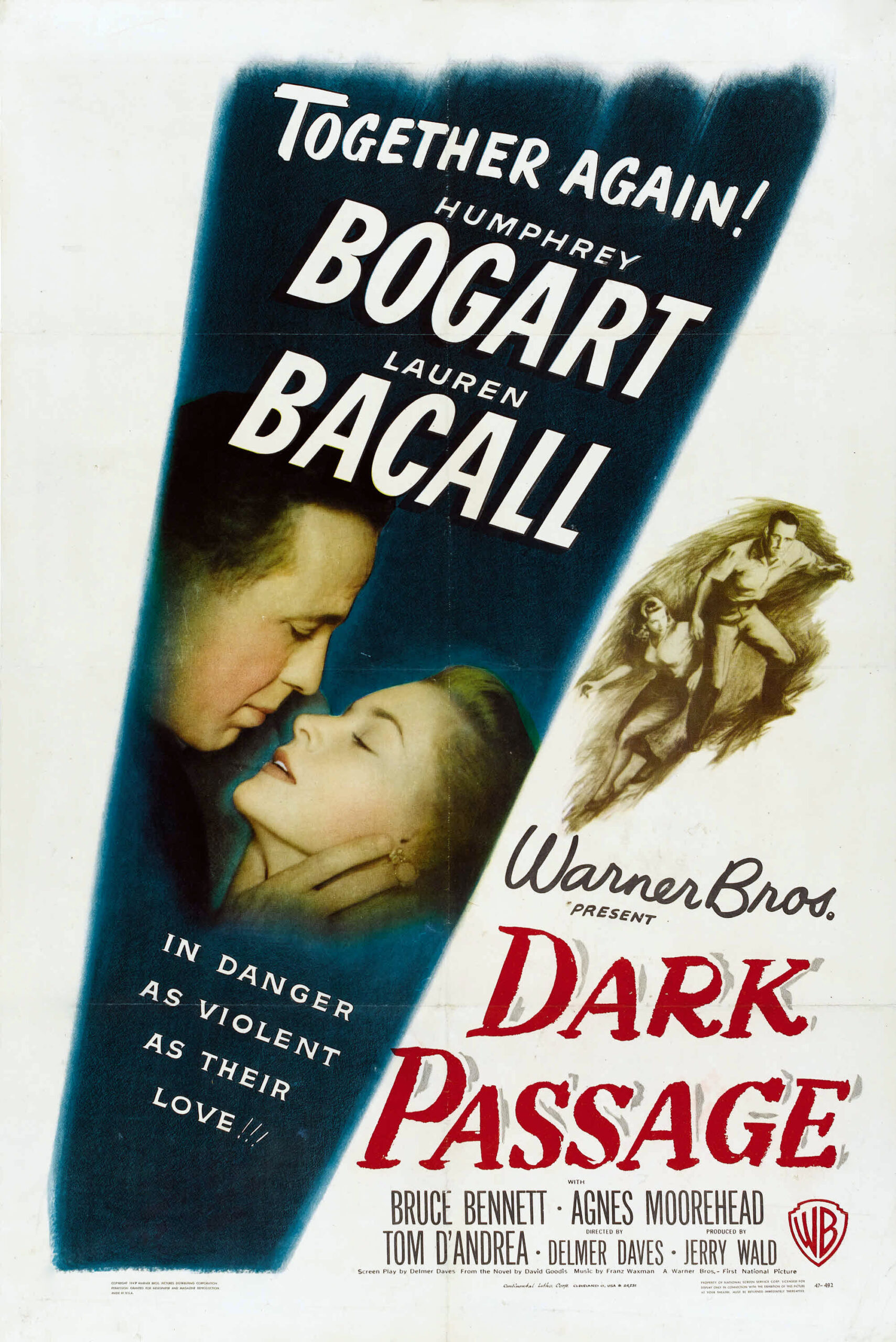
“Don’t you get lonely up here by yourself?”
“I was born lonely, I guess.”
Built on too many contrivances and far too self-satisfied with its central gimmick, Dark Passage nonetheless captivates due to the chemistry between married co-stars Humphrey Bogart and Lauren Bacall.
Its storyline suggests noir—indeed, it is little more than a hodgepodge of genre clichés disguised by cinematic sleight of hand. Consider its pile-up of coincidences: Irene (Bacall) is friends with the vindictive Madge (Agnes Moorehead), who sent Vincent (Bogart) to prison for life with a possibly false testimony; Irene’s own father had been incarcerated under similar circumstances and so she tentatively believes Vincent is innocent even though she doesn’t know him; she’s romantically involved with Madge’s ex-fiancé (Bruce Bennett); she is painting a landscape by the side of the road when Vincent breaks out of San Quentin, for no apparent reason; oh, and she’s conspicuously wealthy so that she can accommodate and care for a fugitive with relative ease.
And that’s just taking a look at one character! How about when Vincent is recognized by a sympathetic cabby (Tom D’Andrea) who happens to know a black market plastic surgeon (Houseley Stevenson) who’ll be ready to operate within the hour? Or how he’s able to walk around San Francisco with a bandaged face during a citywide manhunt and go completely unnoticed?
The gimmick involves keeping Bogart off-screen until after the surgery, which is achieved by shooting Vincent’s scenes from a first-person perspective until about halfway through the film, iterating on a style that had been utilized for the entirety of Robert Montgomery’s Lady in the Lake earlier the same year. It’s a bit overplayed but quite effective at establishing the protagonist’s fear and paranoia; everything and everyone takes on a hint of menace when you’re a hunted man.
There are additional incongruities, but the acting is so convincing that it turns into a weird, surreal, soap-operatic exercise in just how persuasive one can make an incoherent screenplay—which is not something one would expect of journeyman studio workhorse Delmer Daves, who makes his mark here with the subjective camera, a few psychedelic effects during the surgery scene, and extensive use of location shoots.