“Where do you want it?”
“In the butt.”
If only Love Lies Bleeding didn’t let its horniness overbear on its superlative pulp thriller storyline it might have been a great film. Bulging muscles, cracking guns, seedy villains—the raw materials necessary for a genre classic but given a slightly subversive twist and charged up with invigorating style. Regrettably, writer-director Rose Glass gives over much of the movie’s early runtime to lustful shenanigans expecting the audience to swallow it as a love story that might load up its later plot developments with emotional weight. Or maybe I’m just an old man who doesn’t understand the modern methods of falling in love.
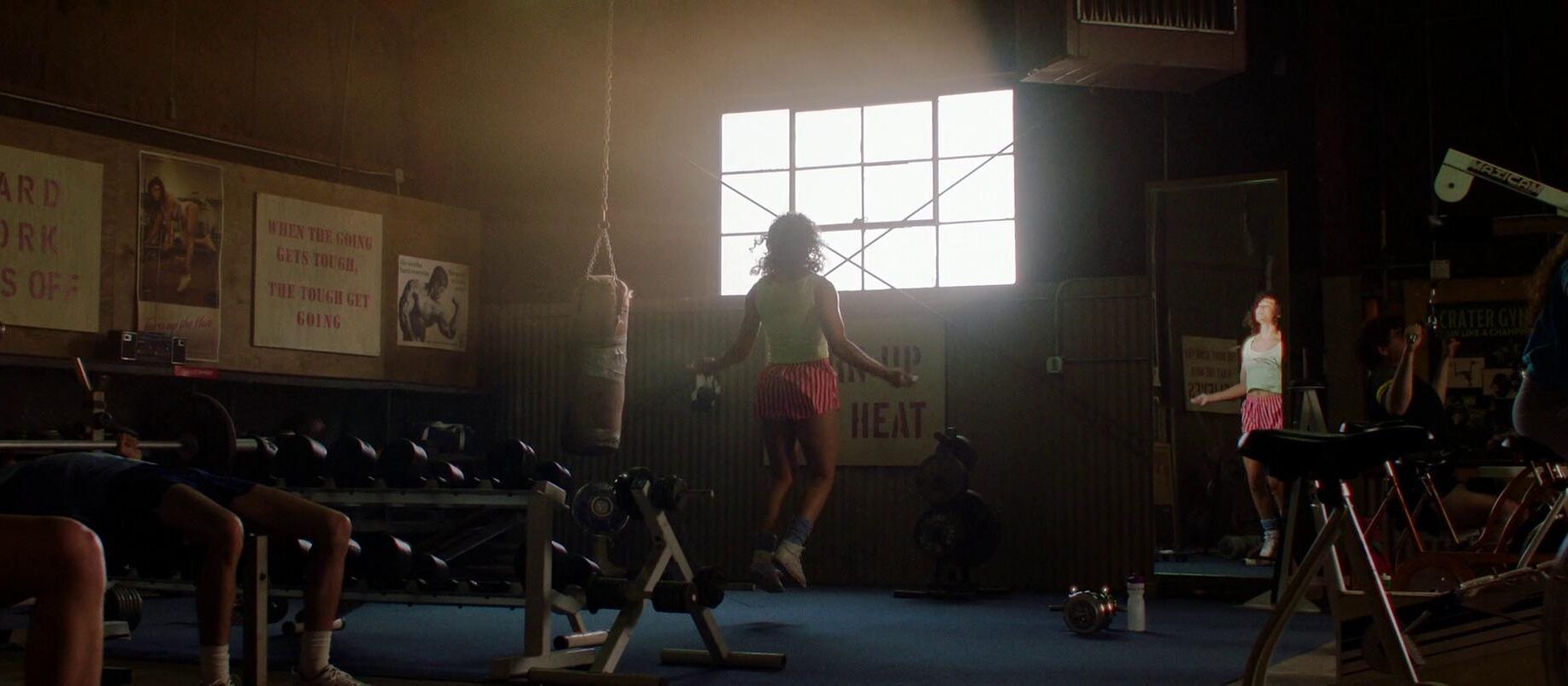
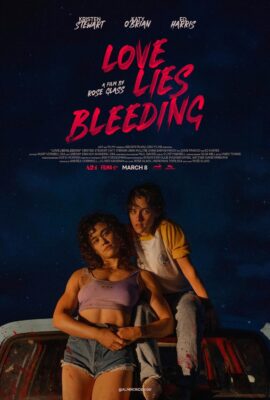
In 1989, Oklahoma farm girl turned statuesque bodybuilder Jackie (Katy O’Brian) is passing through New Mexico on her way to a stage show in Vegas when by chance she falls in with ratty, mulletted, anemic gym manager Lou (Kristen Stewart) whose noodly arms do not align her with the motivational slogans stenciled in bright red letters around the grungy gym. (“THE BODY ACHIEVES WHAT THE MIND BELIEVES.” “PAIN IS WEAKNESS LEAVING THE BODY.”) Lou’s eccentrically evil father Lou Sr. (Ed Harris), likewise mulleted, happens to own a gun range that hires vagabonds as waitresses, as well as half the local police force. Her slimy brother-in-law JJ (Dave Franco), a character of no apparent virtue whatsoever, also mulleted, has a habit of beating on her sister Beth (Jena Malone). The homeless and amoral go-getter Jackie shakes up this hideously dysfunctional family dynamic—in between getting all sweaty and pumped at Lou’s gym, she sleeps with JJ and Lou both, but shacks up with the latter, who offers her free steroids1 that give her a thousandfold strength and a newfound impulsiveness that lead to a fairly grisly escalation of longstanding tensions. Let’s just say there is a face that gets smashed. And then there is no longer a face and yet the smashing continues.
While the story is dramatically sound, Glass and her cowriter Weronika Tofilska improperly abbreviate the narrative, eliding some of the crucial, formative moments that might get us on the hook for the emotional barrage of the latter portions of the film. All films that do not take place in real time—which is virtually all narrative films—of course do this to some degree, so it’s hard to put my finger on exactly why this one feels a little off, beyond simply stating that its narrative elisions and the scenes included where additional story might have emerged do not feel properly attuned to the dramatic heft of the later scenes. I feel like I’m repeating myself, so an attempt to illustrate by example: Having already witnessed Jackie in feral coitus with both brother and sister and having been privy to the steroid episode and the egg yolk kerfuffle, et cetera, what purpose does it serve to spend several minutes having Lou and Jackie discuss and then experiment with how many fingers are best for pleasuring oneself and one another? And then pretty quickly we hop from there to a roadside argument where they’re barking at each other as if long-bottled feelings are spilling out when they’ve only been acquainted for, what, a few weeks tops? Does this earnest romantic fumbling and Stewart’s reliably manic characterization cohere with Ed Harris’s arch camp performance as a gun nut with a fetish for creepy-crawly bugs, or the plot-driving stalker Daisy (Anna Baryshnikov) who belongs to a much lesser film and is fittingly executed in cold blood?
This is not inherently a flaw because many indelible grindhouse films of this ilk exhibit less dramatic inertia—so let’s just call it a minor tonal bungle and say that Love Lies Bleeding really hits a nice stride once it overcomes its sincere-but-poorly-written romance and finds its storytelling groove, which is deep and dark but also suffuse with jet black humor. Glass uses a really nifty style of foreshadowing where characters experience short snippets of foreboding, waking dream visions that straddle the line of diegesis and set the stage for surreal, barbaric flights of fancy in the climactic scenes that lift the film out of its social issue trench and into the realm of exalted grindhouse enrapturement. Even before that, though, there’s a brilliant sequence where Lou and Jackie find themselves with a body that needs disposing; they put it into the trunk of a car, cover said car in gasoline, then push it over a cliff into a desert ravine where Lou knows some other bodies are buried. A molotov cocktail sets the whole thing up in a smoky blaze that feels appropriately apocalyptic and sets law enforcement on a false trail. Moreover, there are several one-off flourishes that I found delightful: an associative montage of yolks and guns and cigarettes and flexed muscles; a freaky Throbbing Gristle–esque warble on Clint Mansell’s soundtrack as Jackie is processed at the police station after going berserk at the bodybuilding show; a nifty drop to silence when Lou makes the conscious decision to issue threats to her father—not to mention a strong use of insert shots, and neon, shadow, and silhouette throughout.
Love Lies Bleeding has some awkward chunks of narrative and inelegantly integrated themes but it is impossible to deny its overall momentum, its fever dream imagery, and its punchy style.
1. To my understanding, O’Brian, who trained as a martial artist since childhood and later competed as a bodybuilder, quit her stage career because she didn’t want to keep up with athletes who used steroids. She wanted to remain natural. That she is here playing a character who is using steroids, while presumably still natural herself, is a testament to her abilities and discipline.