
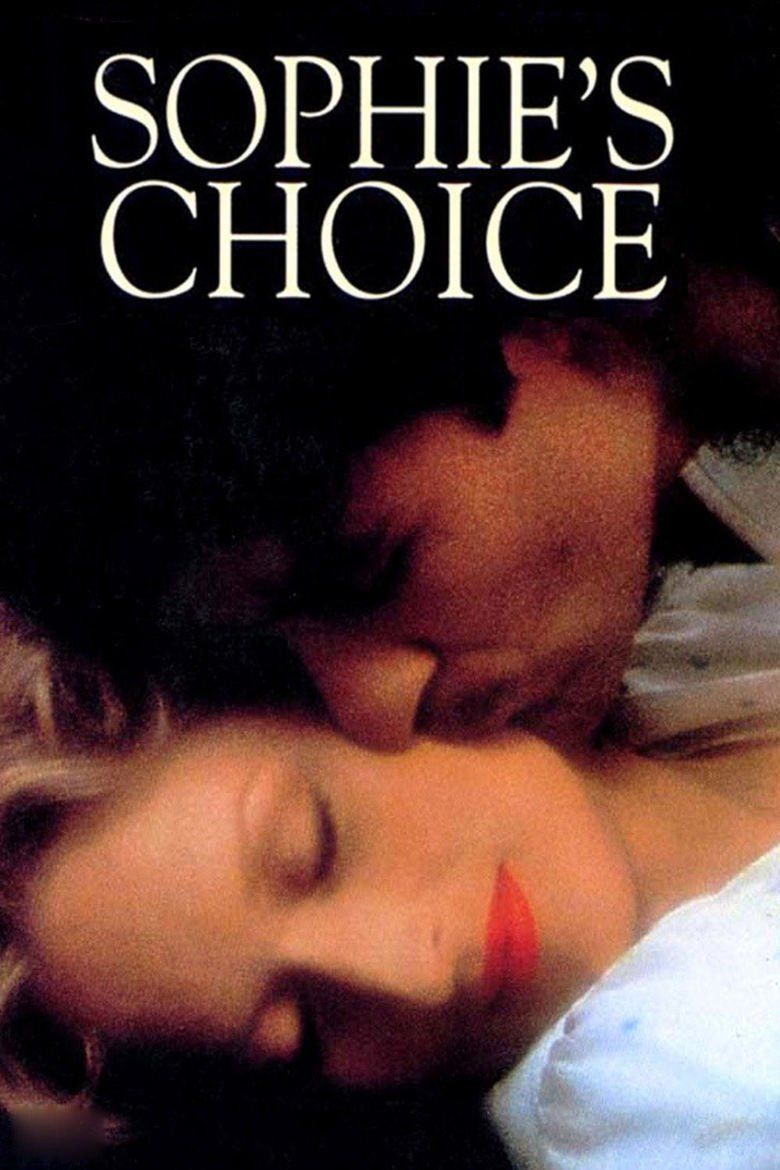
“Don’t you see? We are dying. I longed desperately to escape, to pack my bags and flee, but I did not.”
Sophie’s Choice is one of those films that is so impeccably crafted that its few missteps are painful to acknowledge. The chief blunder here is that there are two disparate stories jostling for control of the main narrative; two stories that both have merit but which writer-director Alan J. Pakula proves incapable of assiduously joining. The result is a frequently brilliant work of art that falls just short because of an unfortunate foundational flaw that was improperly addressed.
The more noteworthy of the two tales centers on the titular Sophie, portrayed by a committed Meryl Streep in an astounding performance that cemented her status as one of the most formidable talents of her generation. Her preparation for the role may seem like overkill—she learned to speak Polish and both lost and gained weight to provide a stark contrast in appearances between the past and present—but it’s hard to imagine she could have so effortlessly absorbed Sophie’s persona had she not been completely immersed. It’s a towering and multi-faceted performance—sensual, delicate, funny, but always haunted by the past. Polish and Catholic, Sophie is mistaken for a Jew by Nazi officers and taken to a concentration camp along with her children. She’s eventually spared, then wanders to Brooklyn where she’s found in an anemic state and nursed back to health by Nathan (Kevin Kline, in his screen debut after honing his craft on the stage), a paranoid schizophrenic scientist who loves and hates her in equal measure.

Although the title of the film and William Stryon’s novel bear the name of Sophie, her harrowing history only features as a small portion of it. Oddly enough, the central narrative, which unfortunately frames the one I just described, focuses on a young Southern boy named Stingo (Peter MacNicol) who has traveled to Brooklyn to write his contribution to the American literary canon and lose his virginity. He moves into a room downstairs from Nathan and Sophie and the trio become fast friends. Nathan is incredibly intelligent and sophisticated but also mercurial. He suffers from wild mood swings that frequently lead to outbursts and nights spent in the streets, followed by passionate reconciliations a few hours later. Rinse, repeat, &c. Despite these volatile episodes, which a smarter man might have taken as a sign to cut ties, Stingo becomes the couple’s loyal companion, learning their backstories in bits and pieces during nights spent consoling Sophie while Nathan is out walking off his aggression. Worse, after striking out with a flirtatious girl who quotes Wilhelm Reich but won’t put out, the lens of Stingo’s sexual objectification settles on Sophie.
Some critics take issue with MacNicol himself. However, the issue is not with the actor but the character he is portraying. It’s certainly true that Streep and Kline are operating at a higher level than MacNicol, and thus the film shines the brightest when Stingo’s role is minimized. However, it’s not as if MacNicol proves overwhelmed by his colleagues, even if he underplays while they act up a storm. It’s simply the case that Stingo is a limp character; a voyeur who appears perpetually fascinated that he’s been allowed to act as third wheel in this tumultuous relationship but is otherwise incapable of turning his feelings into anything more cloying voiceover narration. At first, one might suspect Stingo’s unsophisticated manner is just a humble façade offered by a burgeoning writer. But the narration is just lame purple prose and Nathan’s reaction to reading Stingo’s manuscript (which we never see) is inscrutable because he’s schizophrenic. At first, he’s extremely positive, vigorously conducting an imaginary orchestra and offering his friend a beautiful toast from the Brooklyn Bridge. But later he gives a scathing review and refers to Stingo as the “dreary dregs of Dixie.”
On this bridge on which so many great Americans writers stood and reached out for words to give America its voice… looking toward the land that gave them Whitman… from its Eastern edge dreamt his country’s future and gave it words… on this span of which Thomas Wolfe and Hart Crane wrote, we welcome Stingo into that pantheon of the gods… whose words are all we know of immortality. To Stingo!

These notions of youthful awakening and artistic inspiration born of geographic dislocation are compelling on their own—with most credit for their effectiveness belonging to Kline and cinematographer Néstor Almendros—but they simply don’t jibe with the dark story that they frame.
In any case, if we momentarily ignore that Stingo acts as our centering force, the rest of the film is extraordinarily engrossing. In fact, once we’re transported back to Poland via flashback, Stingo is temporarily ditched. At this point it becomes all too easy to forget about his inconsequential role entirely, to simply not care whether or not he finishes his book or has profound revelations about sex or whatever else. Eventually, Pakula seems to realize this too, as he finally allows Stingo to fade away and gives Sophie center stage as she revises her backstory and confesses for the first time the horrifying choice that was forced upon her.

And yet the more I ponder Sophie’s Choice, the more I feel it is necessary to offer some kind of apology for Pakula’s perceived bungles. Maybe Stingo is reticent because he only realizes that his best friends are doomed after it’s too late. Maybe linking the disparate stories is workable simply because Sophie is present in each of them. Maybe Stingo’s infiltration of Sophie and Nathan’s relationship—where he eventually realizes that he knows both of them better than they know each other—is clever rather than contrived. Maybe, even though we do not glimpse tangible proof that Stingo became a writer, we can understand his frame story as an naïve idealist confronting real human suffering for the first time. In my estimation, it’s worth whatever it takes to talk oneself past the elements that seem poorly implemented in order to relish Sophie’s tale, the world-class acting, the wonderful long takes, and the stellar cinematography.