“Consensus-based medicine means a bunch of doctors think a treatment is a good idea.”
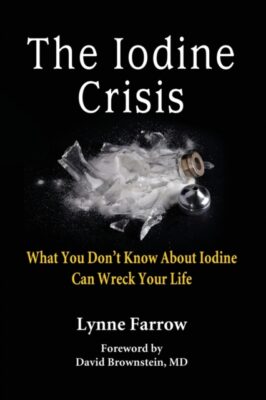
The information presented in The Iodine Crisis is extremely interesting to someone who has suffered from numerous of the symptoms it lays at the feet of iodine deficiency—brain fog, lethargy, apathy, depression. Many of those symptoms could have totally unrelated causes, for sure (I’ve also dealt with a moldy living environment and Lyme disease), but when author Lynne Farrow describes iodine’s historical use, first in the form of various seaweeds and then as the concentrated solution called Lugol’s iodine (formulated by French physician Jean Lugol in the early 19th century), its previous esteem as an essential medicine prescribed for myriad ailments, its falling out of favor due to an unverified and errant theory (the Wolff–Chaikoff effect), its subsequent replacement as a flour fortifier with detrimental bromated flour, and the explosion of various diseases, most notably breast cancer, in the wake of this “perfect storm,” a compelling enough case is built to warrant some cautious experimenting. After all, iodine is in our bodies already; it’s not a drug, it’s a supplement.
While I very much enjoyed the historical overview, with its explanation of the inadequacy of iodized table salt and the root cause of iodophobia and anecdotes about Vincent van Gogh, the structure and style of the book are frankly horrendous, especially considering this is written by a professional journalist. The author haphazardly repeats bits of her personal story almost verbatim, interrupts her main thesis with dozens of testimonials, places its gigantic FAQ section smack in the middle, and circuitously avoids delving into the mechanisms by which iodine actually works. It would flow much better if the author presented her personal testimony, provided a few other strong patient success stories, explored the history of iodine supplementation, then the developments of the last half century; the conclusion would be the recommended protocol itself (with the necessary disclaimer that it’s not medical advice and you should only take supplements if your doctor tells you), with the preponderance of other testimonials punted to an appendix. As is, it reads like a lengthy, scatterbrained blog post with lots of fluff, which very well may be the case.
Granted, though the case studies are distracting, they are certainly more powerful than Farrow’s cursory exploration of the history of iodine. The fact that so many people with debilitating symptoms (goiter, hair loss, breast disease, dry skin) report almost instantaneous relief upon supplementing with iodine is persuasive.
The grassroots support groups that have given legs to the resurgence of iodine supplementation have been legitimated by research from Drs. Abraham, Brownstein, and Flechos, cited by Farrow throughout the book. Brownstein wrote Iodine: Why You Need It, Why You Can’t Live Without It (2008), which is, as one might expect, considered to be much more scientifically rigorous and comprehensive in nature than the book by Farrow, so I’d like to check that one out too.