“Nothing is true, everything is permitted.”
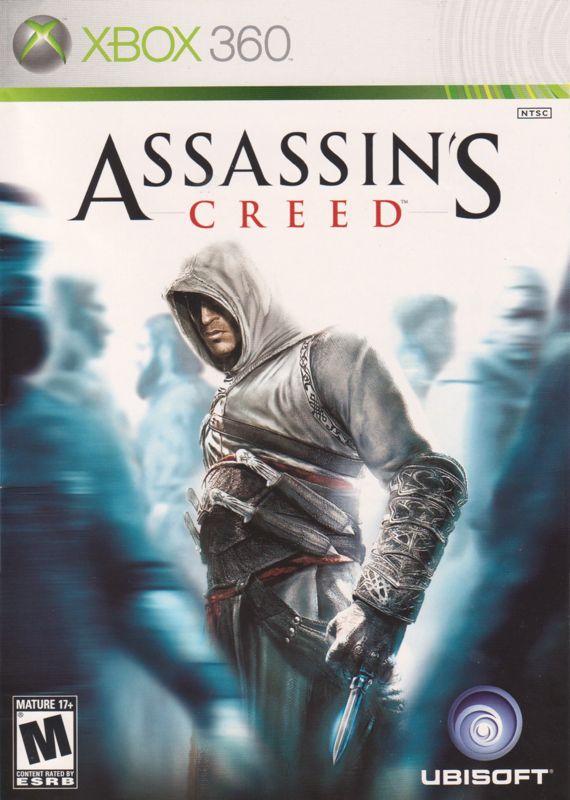
When I first played Assassin’s Creed shortly after its release, I was enamored with its awesome high concept, its period aesthetics, its conspiratorial story, its narrative gravity, its religious bent, its mature themes, its bustling locales, its bird’s eye viewpoints, its rooftop freerunning, its silent takedowns, its bloody combat. This is an ambitious game that in the early going feels like it’s on the verge of transcendence. It still feels this way today, even as it nears drinking age.
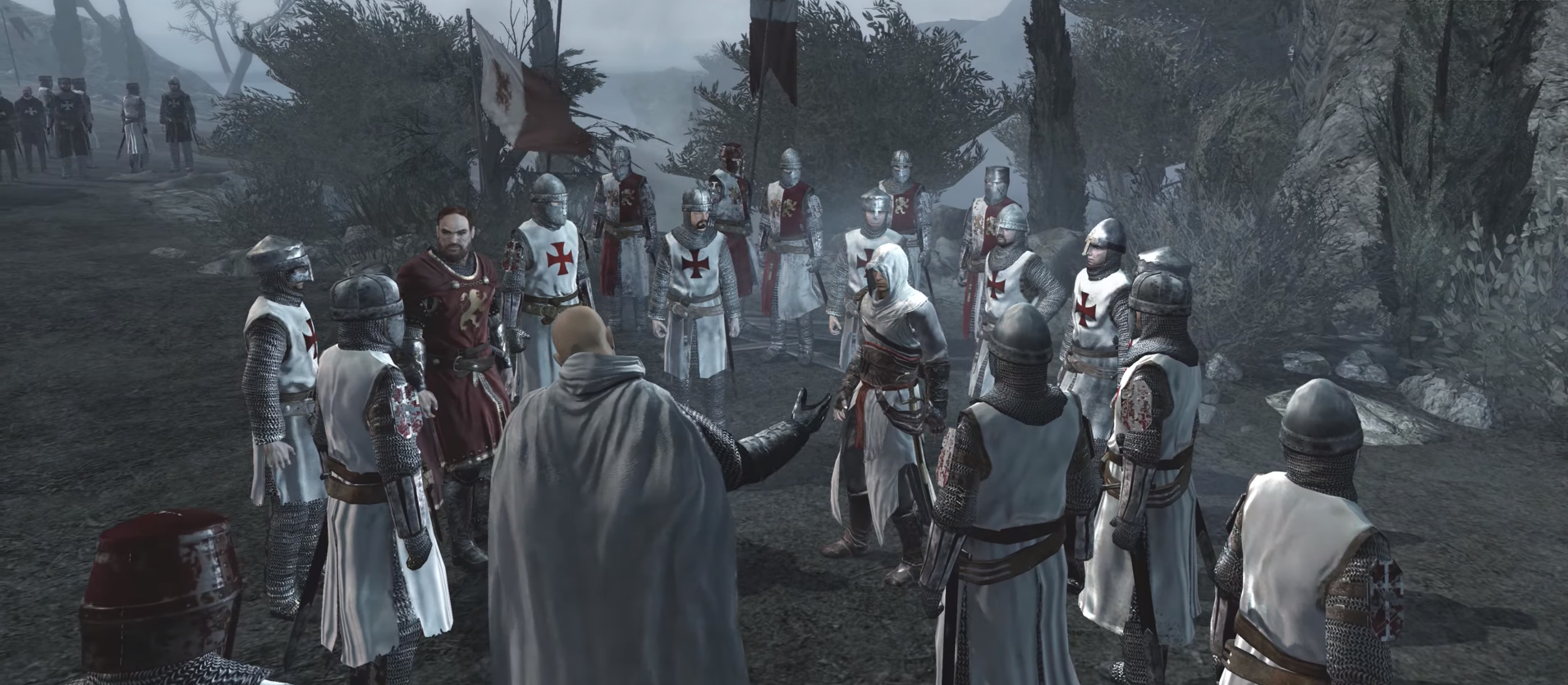
You play as Altaïr, an assassin operating in the Holy Land during the religious crusades of the 12th century AD. Er—actually, you play as Desmond Miles, a modern-day bartender who finds himself kidnapped by a shady pharmaceutical corporation and shoved into a lab device called the Animus which is capable of accessing your ancestors’ genetically-encoded memories and translating them into a simulated reality. Just as Desmond is your avatar, so Altaïr is his. Wow, talk about a high concept! And so you find yourself traveling back in time to live amongst the knights and lepers and ware peddlers and street preachers and monastics. Jumping into the ancient conflict between the Assassins and the Templars, you’ll be tasked with low-level assignments like picking pockets and eavesdropping and interrogating, all of which build to—what else?—targeted assassinations, where a hidden blade issues out of the gap in your first where your ring finger used to be and plunges into your victim’s neck. These dramatic assassinations are carried out in order for Altaïr to regain his lost honor and to recover a mystical artifact of such immense power that its effects in Altaïr’s story ripple forward into Desmond’s timeline.
While still taken with the sweep of the Dan Brown-esque narrative, my latest playthrough of Assassin’s Creed (my first since way back when, undertaken because I’d like to make my way through the… gulp, thirteen sequels, and counting) revealed a few foibles. Namely, a penchant for protracted dialogues that do not further the story or expand the mythos or raise any interesting philosophical points; a certain slowness to the climbing maneuvers that is more suited to relaxing exploration than intense chases; a bland repetitiveness to the mission structure; a decided lack of the stealth promised by the game’s opening cinematic; and a simplistic combat system that boils down to a matter of timing (nevertheless, combat looks great).
After about the third of nine assassinations, the process starts to feel like a tedious chore, even if climbing to a new vantage and synchronizing with the environment remains a satisfying experience akin to the Agency Supply Points of Crackdown. Ubisoft definitely put in the time to develop the wider story and the atmospherics, and to fine-tune the minutiae of its primary gameplay mechanics, but they dropped the ball when it comes to the game playing out in a satisfying manner over the course of a playthrough. If it begins to feel too much like work, though, it’s still work worth doing because the story remains engaging and, up until the formula becomes excruciatingly apparent, the overall experience is a heck of a lot of fun.
It may not live up to its full potential—which would be an action-adventure game with a great frame story that shifts between stealthy maneuvers, acrobatics, and violent outbursts; a delirious hybrid of Grand Theft Auto and Prince of Persia and Tenchu and Hitman—but the basic mechanics of Assassin’s Creed provide a satisfying game feel that has presumably been iterated on in subsequent entries in the series and integrated into more cohesive and complete gaming experiences. I look forward to revisiting Assassin’s Creed II and running amok in Renaissance Italy. Maybe this time I’ll remember to hug Leonardo da Vinci.