
“You shall eat the flesh of your sons and the flesh of your daughters.”
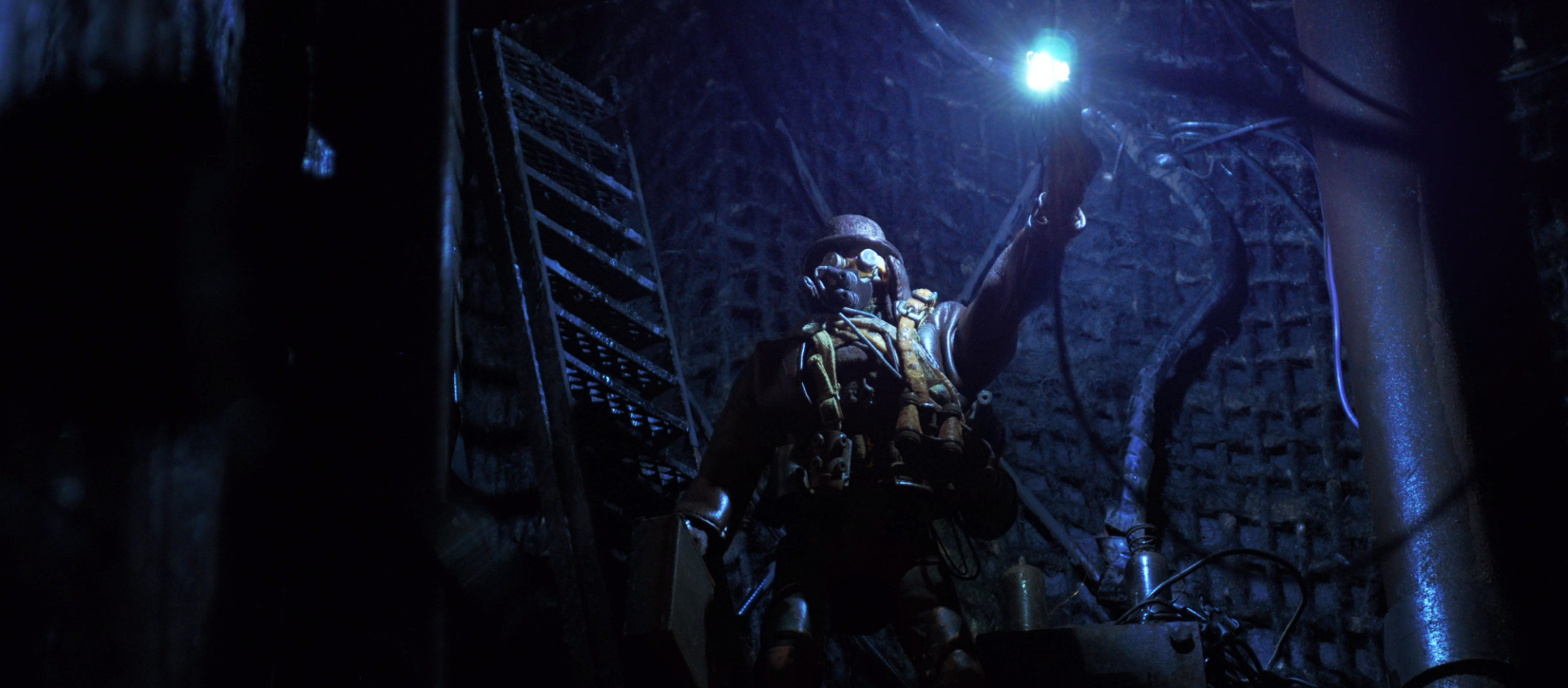
There’s nothing new under the sun, but Mad God is pretty dang original. It takes a few verses from Leviticus and strips them of all context, then posits a world in which, well, God has gone mad. A gas-masked and bowler-hatted explorer descends in a diving bell to a desolate subterranean wasteland marked by despair and depravity where everyone speaks gibberish after a Tower of Babel–like event. The landscape is littered with dinosaur skeletons, titanic skulls, and discarded idols. Broken pipes jut from broken concrete. Slime coats miscellaneous surfaces. Monsters rip each other apart and brutal overseers abuse slaves. Most of the moving parts are at once mechanical and biological, functions in a grand cosmic machine that we comprehend only vaguely and symbolically.
Renowned for his character design and stop-motion effects work on films like Star Wars (1977), Piranha (1978), and RoboCop (1987), writer-director Phil Tippett conceived and began work on Mad God while working on RoboCop 2 (1990), shelved it during the production of Jurassic Park (1993), believing stop-motion to be a dead art form, and reviving it over 20 years later with the help of volunteers and a Kickstarter campaign. None of the aforementioned films, even the relatively gnarly RoboCop, dial the viewer into the wavelength of Mad God. To set expectations, think of Eraserhead (1977), Fantastic Planet (1973), Salò, or the 120 Days of Sodom (1975), William S. Burroughs’ Naked Lunch (1959), and the netherworld collage paintings of Hieronymus Bosch. And whoever did the accompanying Foley work certainly earned their paycheck with an atmospheric cacophony of infant cries, chugging engines, ticking clocks, sirens, music boxes, gunfire, and unintelligible chirps of speech. Mad God is vivid, surreal, appalling, miserable, oppressive, inhumane, a procession of grotesque violence and suffering.
Primarily a work of stop-motion animation in the mold of Jan Švankmajer or the Brothers Quay (with some puppetry and live action mixed in, and a glaring digitally animated segment), the film is a visual feast for those inclined to appreciate the craft behind their entertainment. The creations here are a wonder to behold. An intellectual appreciation of the painstaking craft required to capture all of this the “old-fashioned way” helps temper the effect of the gruesome images on screen: pitiful creatures ground into goo and dumped into the mouth of a giant whose organs are external, surgeons skinning a live man before a live audience, tiny dwarves squashed beneath a boot, brains wired into television sets, women hanging in suspended cages, pustulent homunculi, slaves made of feces and hair. The apotheosis is a sloppy, exploratory surgery to extract an infant larvae from a man’s chest cavity, which will, in the hands of a hovering plague doctor and an alchemist, become the seed of a new universe. In its way, it is an examination of filth, death, and war, of the Fall of Man, everyone toiling toward unknown ends: small, tortured cogs in an invisible cosmic machine known only to the underworld denizens by the rotten, baby-voiced mouths barking orders at them from screens mounted throughout the realm.
I have no idea what Phil Tippett believes about his “source material,” but many critics have inevitably jumped on the wagon to claim that Mad God is somehow an accurate representation of the God of the Bible. Ha! As if the wild-eyed lunatic played by Alex Cox (director of cult films like Repo Man [1984] and Sid & Nancy [1986]) is anything more than a caricature. It’s like an atheist debater asking why Christians think it is good when Lot offers his two virgin daughters to a violent mob or when David sends a man to the frontlines of war so he could claim the man’s widow as his own. The answer, of course, is that we don’t. Not everything depicted in the Bible is good—in fact, much of the Old Testament is characterized by evil running rampant in the world. War, disease, famine, idolatry, depravity. The Aaronic priests spent their days chopping firewood and butchering sacrificial animals. But wait, there’s this second part that contains the Gospel, where the Logos becomes flesh, walks among us, and redeems mankind. Have you heard of that?
Stripped of the filmmaker’s legendary pedigree and the backstory about its long gestation, et cetera, the film might lose some of its grimy luster. Tippett is by trade a definitionally detail-oriented craftsman; on many films, his entire artistic world is a single character or a single scene. He clearly has the chops for stop-motion animation, but corralling a feature-length vision of this caliber and ambition into a cohesive and satisfying film stretches his skillset considerably. It would be fair to regard Mad God as Phil Tippett’s own little universe, one he’s overseen for 30 years; he therefore may be the mad god of the title. Critiques aside, Mad God deserves to be lauded as one of the most original and audacious works of stop-motion animation in the history of the medium.