
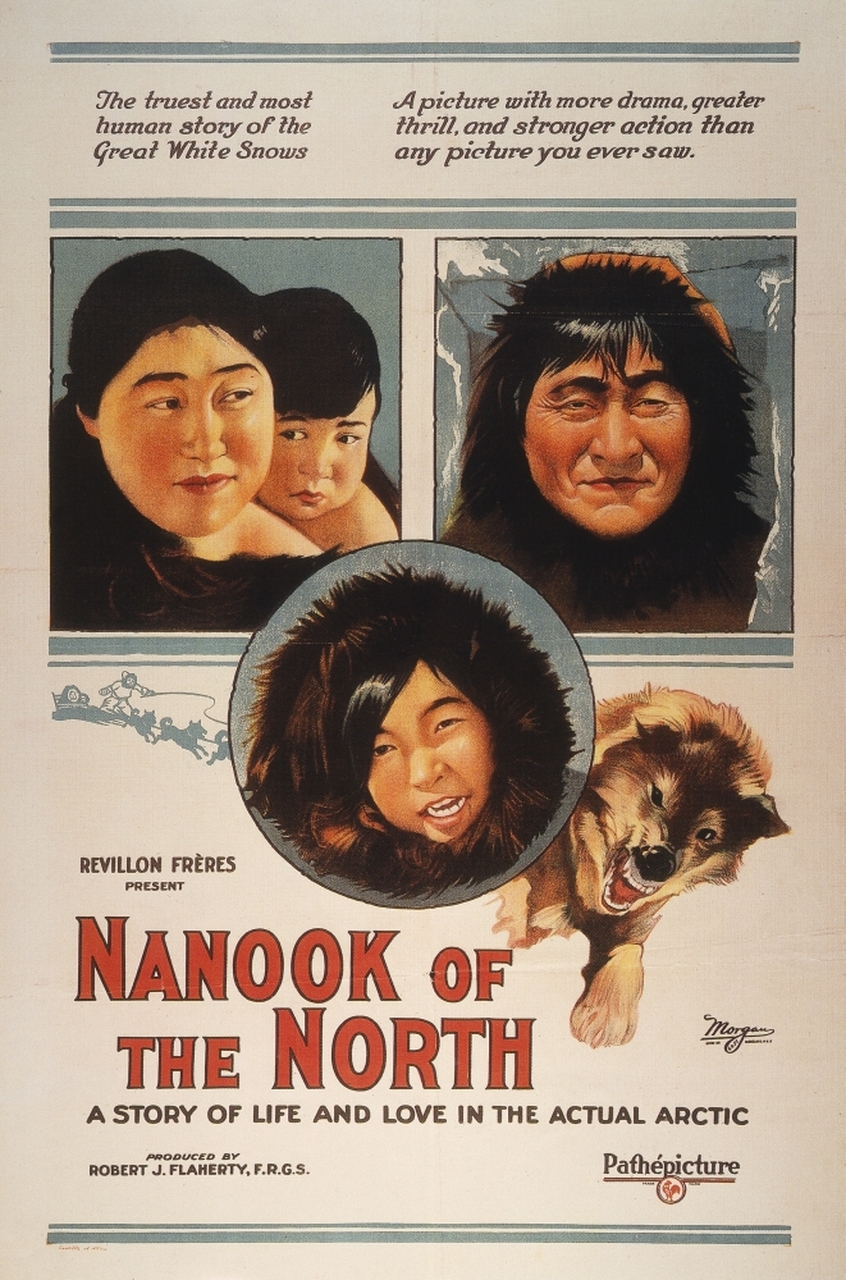
“The shrill piping of the wind, the rasp and hiss of driving snow, the mournful wolf howls of Nanook’s master dog typify the melancholy spirit of the North.”
Broadly influential, controversial, and underseen, Nanook of the North is simply unavoidable when discussing the history of documentary film. Though documentary films existed long before Robert J. Flaherty traveled to the Arctic Archipelago—indeed, the majority of early motion pictures were of the nonfiction, non-narrative variety, e.g. the Lumière brothers’ short “actuality” films that depicted industrial workers and factory processes; filmed surgeries used to train other doctors; patient studies to analyze neurological illnesses; boxing matches screened nationwide—Flaherty’s Eskimo adventure stands as an early landmark of the format, even if it doesn’t properly define it. Indeed, it can be argued that it’s not a documentary at all.
Nanook of the North was an entirely different kind of project than those early works: a feature-length effort that had a clear narrative structure, that connected with its characters, that included invigorating action sequences, humor, and insight into its subjects. By digging into the culture of the Intuit people, how they lived, gathered food, built homes, and entertained themselves, Flaherty tapped into two strands of earlier non-narrative film styles, those that focused on everyday toils of working people and those that explored exotic locations. While its length and narrative shape were both quite novel at the time and are sufficient reasons to peg it as an antecedent of the the format proper, it was met with some degree of controversy that must be addressed.
You see, even though Flaherty’s incredible footage of Nanook was shot on-location in harsh conditions with a minimal crew, even though the filmmaker lived with the indigenous people for years as he documented their way of life, even though the legendary Intuit hunter killed and ate the raw flesh of a real seal on camera, even though the clothes, watercraft, and tools the Eskimos used were all handcrafted, even though the family built an airtight igloo in under an hour, complete with a window made of ice—despite all of these markers of authenticity, much of Nanook of the North was effectively staged. Its depictions are not false, per se, just contrived. As it turns out, Flaherty’s “documentary” does not accurately depict the Intuit way of life circa 1920 but a romanticized vision of their recent heritage. That is to say, Nanook of the North is not an anthropological study of the Intuit people as Flaherty found them, but an exceedingly authentic reenactment of an earlier generation. Thus all hints of Westernization were scrubbed from the depiction. Buildings, clothing, and firearms were deliberately kept offscreen. Outboard motors were taken off kayaks and replaced with wooden paddles. (The paddles were made by hand, of course, just like the kayak with its sealskin exterior.) Nanook isn’t actually Nanook (a word that means “polar bear” in Inuktitut), but Allakariallak. And his family is not actually his family, but a collection of photogenic Intuit people, two of whom were apparently common-law wives of Flaherty himself!

By the time he set out to film what would become Nanook of the North, Flaherty had lived among the Intuit people for a number of years, first as a hired explorer prospecting for iron ore, then as a documentarian, encouraged by a three-week course in basic filmmaking and development at the Eastman Kodak Company. He shot tens of thousands of feet of footage, often screening the work-in-progress for the subjects themselves. Unfortunately, during editing, or “assembly” as Flaherty preferred to call it, a stray cigarette ash alighted upon the original negative and ultimately claimed thirty thousand feet of film. And so Flaherty returned to the Intuit people, not to recreate his original picture verbatim, but to focus on a small family that would exemplify the authentic Intuit way of life he desired to capture on film. Using a wildly idiosyncratic method1 that would typify his approach for the rest of his career, he crafted the remarkable Nanook of the North.
This knowledge of the film’s partial artifice certainly affects how one views it. For instance, there’s a sequence in which Nanook sneaks up on a herd of seals, harpoons one, and then exerts himself wrestling it onto the shore with a few other hunters. Firsthand accounts indicate that several additional helpers are just offscreen assisting Nanook as he tugs on the rope, and that the finale was reshot with an already-dead seal for a better presentation. In another instance, a half-igloo was built to capture footage “inside” an igloo because regular-sized igloos were too small to fit a bulky camera and too dark besides. With this knowledge in the back pocket, such sequences tend to shift the audience’s attention from the subject to the performance. However, the mere fact that the Intuit people had access to factory-produced clothing and rifles doesn’t make the production of Nanook of the North hopelessly artificial. Far from it. Actually, it’s the practiced familiarity that Nanook exhibits that makes the film so convincing and fools the viewer into thinking it is completely authentic. Ultimately, I find that it simply doesn’t bother me that Allakariallak took on a new name, pretended that he’d never seen a gramophone, and hunted without the rifle he had learned to use. I remain unfazed by these details because what he does is not false at all. He may have allowed Flaherty to give him a new moniker and request that he perform certain actions for the camera, but he had spent a lifetime honing the skills that are on display in the film. As Roger Ebert wrote when reviewing the film in 2005, “If you stage a walrus hunt, it still involves hunting a walrus, and the walrus hasn’t seen the script.”

In fact, one could argue that in the lawless early days of film, before standards and norms had been established, Flaherty was working without precedent and so could hardly be accused of trickery. He never denied that scenes were staged and there was no convention that told him not to do so. Indeed, the hands-off approach that documentarians purport to follow today was not common practice then. Unfortunately, many modern readings of the film tend to skim through the film’s special qualities in order to arrive at the fact that its narrative was designed. But so okay, let’s say it’s not a documentary at all, for the sake of argument. Then what is it? It’s an Aguirre-esque exploration of the Eskimo’s heritage, starring Eskimos who had recently begun to adopt Western technologies, but who still knew how to use the primitive tools they grew up with. In this sense, there’s nothing false about Nanook of the North. The demonstrations of these tools are no less real or historically valuable just because guns and motors had been introduced a few decades prior. One cannot deny that these men, women, and children actually journeyed out into the unforgiving yet majestic landscape to document seal hunts, igloo builds, dog-sledding, and ice fishing using authentic implements. From the humorous, lengthy opening shot of Nanook’s “clown car” kayak, from which his entire family emerges, to the nurturing scenes of Nyla and her baby, to Nanook’s heroic exploits, it’s a fascinating and endearing time capsule.
1. Check out the article linked below this footnote for more details on Flaherty’s unique production methods, including living amongst his subjects for years at a time, selecting the prototypical family unit, constantly screening footage, asking subjects to perform actions over again, taking years to “assemble” the final cut, etc.
Sources:
Cameron, Evan William. “Growing Things: The Rural Patience of Robert Flaherty”. York University. 1994.