
“Fist my bump.”
Creative powerhouses like Charles Dickens, Agatha Christie, and Alfred Hitchcock all used amnesia as a storytelling telling device, so it is probably unwise to totally dismiss the “Jason Bourne framework” out of hand, but in the case of Project Hail Mary, adapted from Andy Weir’s 2021 novel, its deployment is particularly egregious. After Dr. Captain Rylan Grace (Ryan Gosling) awakens and stumbles bewildered around the Project Hail Mary for a few minutes in the opening scene and quickly remembers that he’s smart, resourceful, et cetera, the gradual return of the rest of his memories about his space voyage is not functional to the plot at all, but rather a pointlessly clever way to withhold backstory from the viewer. There’s nothing wrong with simply providing backstory out-of-sequence when it makes narrative sense to do so, and, with the lone-man-in-space setup, there’s ample justification for him not to talk about the backstory outloud until it becomes pertinent!
I digress, and apologize for leading with my primary complaint about an otherwise fairly uplifting blockbuster sci-fi movie.
The hook is pretty cool. A microscopic alien organism is slowly eating the sun and every other star in the galaxy, except one, and Grace, a disgraced molecular biologist now teaching middle school physics, is the single maverick Poindexter among hundreds assigned the same task by the stoic project leader (Sandra Hüller) who discovers how to breed Astrophage, as it is called, and which can coincidentally be used as rocket fuel, which, in said application, due to a measurement error, blows up the prospective astronauts who are set to travel to Tau Ceti to determine why the Astrophage isn’t eating it, and thus, due to his deep knowledge of all things Project Hail Mary, Grace is, against his will via a forcibly induced coma, packed into a spaceship and flung into the stars, only to wake up with selective memory loss and two dead crewmates (Ken Leung, Milana Vayntrub), until, unexpectedly—except we should expect theoretical alien lifeforms to have the same idea of surveying the one undying star if all the other ones are dying—he encounters Rocky, a spidery alien golem from a civilization facing a similar extinction-level crisis, who breathes ammonia and uses echolocation to see and speaks in a musical language and 3D prints solid xenon with his appendages, and the two of them, despite having nothing in common beyond curiosity, ingenuity, and compassion, become the unlikely vanquishers of the Astrophage (or, as the film so queasily puts it, the “saviors of the universe”). According to my wife and unsurprisingly, all the science stuff is fleshed out to the nth degree in the book, but is quick and breezy in the film.
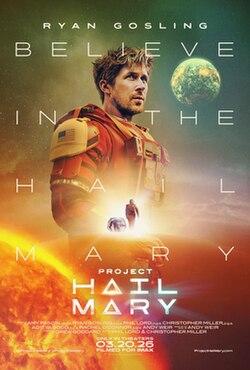
Directed by Phil Lord and Christopher Miller (The Lego Movie [2014]) from a screenplay by Drew Goddard (Cloverfield [2008]), Project Hail Mary, though an effects-driven spectacle film with calibrated emotional swells and whatnot, is entirely dependent on Gosling’s comedic talent and his chemistry with puppeteer and voice actor James Ortiz, who plays Rocky. (It relies to a lesser extent on Gosling’s rapport with Lionel Boyce’s Carl, a security officer who gets caught up in helping Grace with his scientific experiments on earth prior to the mission. He gets to deliver a cool line that informs the audience that Project Hail Mary is truly a worldwide collaborative effort—despite probably true claims that the world’s governments would not fairly ration food during the impending cataclysms, the notion that they’ll at least cooperate on this last ditch effort is a neat and subtle optimistic touch.) Goddard’s script maintains a consistent, humorous tone, while Lord and Miller’s hyperkinetic style makes room for a bunch of improvised/outtake-type moments between the two leads, includes many inspired, off-beat and eclectic needle drops, and features an abundance of visual gags and clever cuts.
The novel is considered hard sci-fi, but I would not qualify the film adaptation as such. Having read Weir’s The Martian (2011), I’d assume there’s a ton of elaboration on the biologies of the Astrophage and Rocky’s alien race, comatose space travel, breeding microorganisms, translating alien speech, et cetera, all of which gets more or less hand-waved to try to cram the entire plot into a 156-minute film that unsuccessfully tries to evoke that sense of wonder that much good speculative fiction achieves. This tips the scales toward saccharine entertainment which reaches its zenith (or nadir, depending on your view) with a succession of deflating false endings, and away from self-serious takes on similar premises like Interstellar (2014) and Arrival (2016), which is not a crime, but does cause a bit of a tonal wobble when the buddy comedy elements are regularly juxtaposed with the pre-mission earth scenes in which the grave stakes are soberly addressed by the deadpan Hüller. Again, there’s nothing inherently wrong with these creative choices, and I would even say that there is plenty of comedy inherent in the juxtapositions, but they underwhelm a viewer with an appreciation for the research behind Weir’s stories and who has seen a reasonably faithful adaptation of his hard sci-fi storytelling in Ridley Scott’s adaptation of The Martian (2015). Having not read Project Hail Mary and so at risk of eating my words when I finally do, I’d hazard to guess this film version will be a better companion piece to the book than a thorough audiovisual adaptation of it.
All things considered, it is a consistently pleasurable, relatively family-friendly, eminently watchable movie that harkens back to sci-fi adventure movies of the 1980s; one I’m likely to rewatch at least once or twice in the years to come, but it feels a bit too slight of theme, character, and emotion for a film that approaches the 3-hour mark. If Solaris (1972) is meat-and-potatoes sci-fi and Contact (1997) is a fancy restaurant meal, Project Hail Mary is a tasty TV dinner.