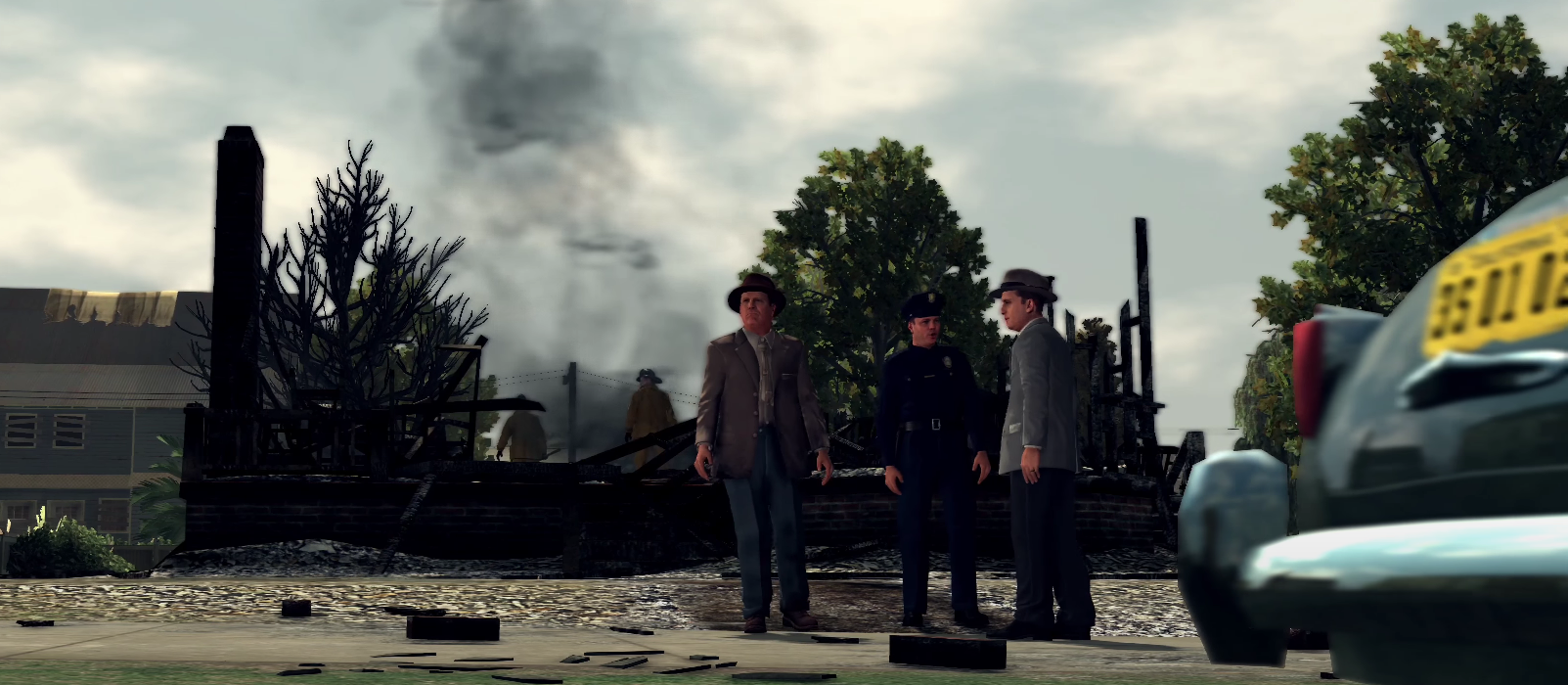
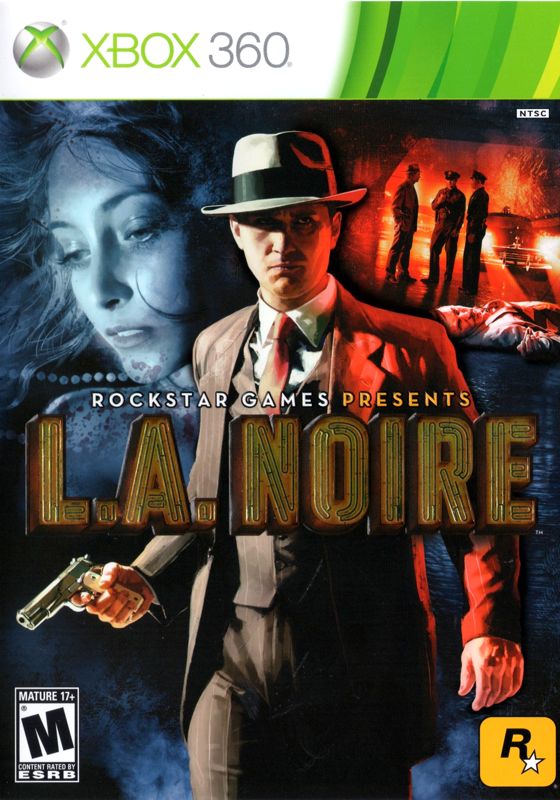
“A city of pioneers. A city of dreamers. A city of undercurrents, where not everything is as it seems.”
Having a deep affinity for the material that inspired L.A. Noire—think The Big Sleep, Chinatown, and the novels of James Ellroy, with all their seedy glamor, murky moralities, backroom conspiracies, hazy shadows, sleazy gangsters, crooked cops, femme fatales—I’m undoubtedly predisposed toward enjoying my time with it. Simply luxuriating in its rich environments, soaking up its Old Hollywood flavor and lovingly clichéd detective story and original score, and marveling at its excellent acting and motion capture animations is enough for me. But even my eye, looking through a tinted lens, can see that it’s a flawed gem.
The game’s primary shortcoming is that it is marooned in a no man’s land between a role-playing action game and a bloated, big-budget version of those interactive, old-school adventure games like Broken Sword: The Shadow of the Templars and The Secret of Monkey Island or the works of Telltale Games. Not that it has to be one or the other, but it’s neither and not a good hybrid to boot. You get sucked into the story of stoic WWII vet Cole Phelps’ rise through the ranks of the LAPD, from Patrol up through Traffic, Homicide, Vice, and Arson, all of his personal and professional entanglements, and the dangerous world he inhabits. As you become immersed, the last thing you want to do is get pulled away from that unfolding story to engage in bits of tedious gameplay that are unintegrated into the overall package. And yet that is exactly what you’re asked to do.
Unlike the barely-a-game Heavy Rain from the year prior (which was developed by Quantic Dream), L.A. Noire was developed by Brendan McNamara’s Team Bondi with oversight from publisher Rockstar Games, which means it comes with all the bog standard Rockstar miscellany: a sandbox environment, car chases, shootouts, fisticuffs, rambling NPCs. These traditional game elements are precisely what make L.A. Noire a game rather than an interactive movie. But while they’re just as serviceable here as they are in Grand Theft Auto, they simply do not mesh with the hyper-scripted and linear sweep of its presentation. Indeed, to break away from the main narrative and explore the spectacularly detailed but oddly lifeless open world almost feels like an act of transgression when the core experience is a point-and-click detective game that uses Pavlovian controller rumbles and chime noises to lead you by the hand through the gumshoeing segments and places its intense-but-unfailable interrogations on a prominent pedestal.
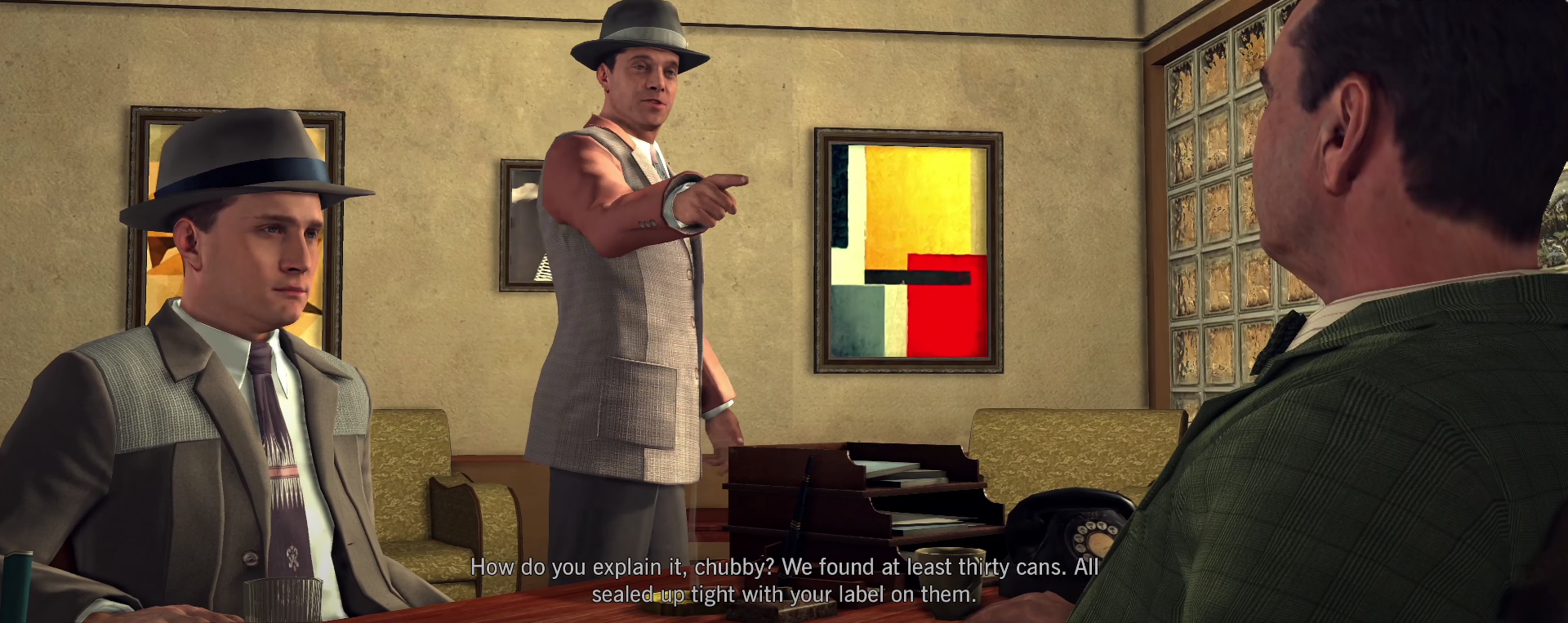
What’s strange is that even though the clue finding and puzzle solving and traversing of the map in a law-abiding fashion make for a very low-key gaming experience, the game’s nigh magical use of motion capture ensures the player is utterly engaged in the murky, frustrating, hit-and-miss practice of interrogation in which the player can only vaguely guide the loose cannon protagonist. Neither the rigid interrogation tactics nor the very unsubtle investigative hints nor the subconscious understanding that your crime solving success or lack thereof will not affect the overall narrative nor Cole Phelps’ failure to conjure up the mystique of a Sam Spade or Philip Marlowe can totally prevent the player from actually kinda sorta sometimes feeling like a 1940s sleuth.
And so it’s the gamier bits that distract, even though they’re the reason that it’s really a game at all! I don’t want to suggest that L.A. Noire exists solely to convey its story—partly because its story evolves into a wonky concoction that doesn’t quite end in a satisfying manner and partly because it is somewhat successful with its detective mechanics—but it certainly feels like the emphasis was on story and atmosphere, with too little attention spent considering how those two things would be incorporated into a rewarding gaming experience. Or even a narrative experience. Its plot tees up set pieces that are lackluster and its gameplay takes a backseat to a story that ultimately comes up a skosh short, and too seldom are we encouraged to stop and smell the roses in 1940s Los Angeles. No one wins, except me, because I am ultimately content to drive around this painstakingly rendered version of post-WWII L.A. in a Phantom Corsair.