
“Care for a little necrophilia?”
Terry Gilliam’s magnum opus manages to be so many things at once that it is truly staggering. Quirky and absurd, yet borderline prescient, Brazil presents a mish-mash retrofuturistic dystopia wherein society is ruled by an overbearing class of persnickety narcissists who will do anything but serve the populace. Skyscrapers jut thousands of stories into the air, choking out the sky, crowded with neon signage and crawling with wires, pipes, pneumatic tubes, electronic gizmos, mechanical doohickeys, and cameras. A sprawling computer system manages the daily operations of the nameless metropolis and a profusion of half-functional gadgets have replaced common household appliances. The whole city operates like an interconnected slapdash assemblage that’s barely kept from disrepair by an endless succession of cheap band-aids applied by the downtrodden rank and file. It’s within this dreary and hopeless setting that our despondent protagonist, an unambitious paper-pusher who simply wishes to correct a typo so he can get back to his daydream fantasies, gets roped into a zany adventure that brilliantly illustrates the madness of the modern world.
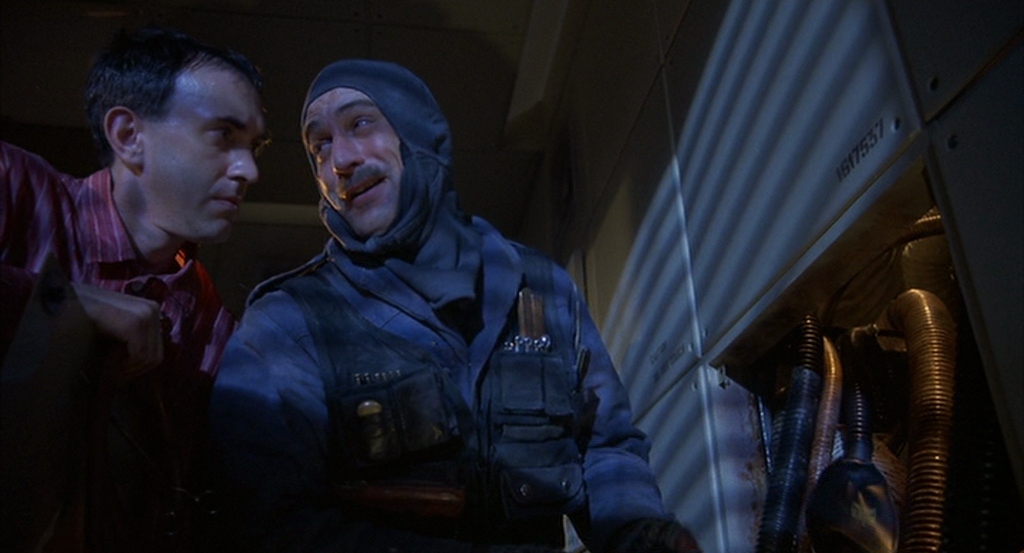
Set “somewhere in the 20th century,” the events of Brazil hinge upon a solitary computer error. The Ministry of Information is conducting inquiries into the actions of a renegade heating engineer and suspected terrorist named Tuttle (Robert De Niro). Tuttle is a wanted man because he’s quit his job at Central Services in protest of the organization’s penchant for tedious bureaucracy. Now he’s a freelancer, covertly monitoring phone lines for leads and providing cheap service without all the headache of regulation and documentation. In other words, he’s a free man living his dream of fixing haywire HVAC appliances in exchange for money. A true radical. This act of defiance doesn’t sit well with the Ministry. Tuttle’s supposed to be brought in for interrogation (read: torture), but, due to a bug—a literal bug—one of the countless teleprinters humming and clacking within the harshly lit bowels of the Ministry has emitted an arrest warrant not for Archibald Tuttle, but for Archibald Buttle (Brian Miller). Buttle, a hapless cobbler, is quickly apprehended, stuffed into a straightjacket, and whisked off to “interrogation” by a squad of faceless soldiers with machine guns. Of course, this vital public service is not free, and so Mrs. Buttle (Sheila Reid) is forced at gunpoint to sign a receipt acknowledging the torture of her husband and agreeing to promptly pay for it.
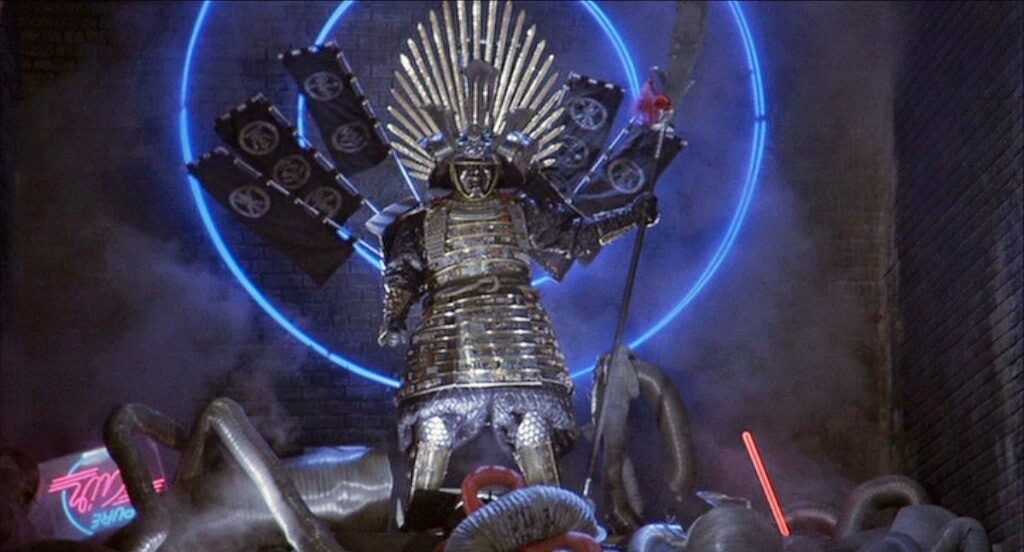
At the Ministry, Sam Lowry (Jonathan Pryce)—the aforementioned protagonist—identifies the hideous error but decides to ignore it because it was the fault of another department. His butt’s covered so why bother following up on it? He’d rather ignore his banal existence and daydream, escaping into his imagination where he plays a silver-winged knight fighting tooth-and-nail against an armored samurai to save an angelic woman (Kim Greist). But when he catches a glimpse of this fantasy lady in the flesh while hand-delivering Mrs. Buttle the refund for her husband’s torture (and accidental death), his life is irreversibly altered. He decides to take a brave step by accepting a promotion he’d previously turned down to avoid responsibility in order to gain access to classified information. It turns out that Jill (Greist) is a truck driver who lives above the Buttles. She witnessed Mr. Buttle’s erroneous arrest when the intimidating soldiers cut a hole through her living room floor and jumped down into the Buttles’ abode to make the grab. Since that day, she’s been futilely pinballing between vaguely named Ministry departments in an attempt to right the wrongs done to the Buttles, but each impersonable clerk she encounters tells her she needs some form or stamp only obtainable elsewhere. Lowry is able to glean this info because the Ministry has pegged Jill as an accomplice of Tuttle for her efforts in trying to report the wrongful arrest of Buttle. It sounds ridiculous, doesn’t it? But not far-fetched.
As Sam gravitates toward these two attractive outsiders, the free-spirited Tuttle and the hot-blooded Jill, his outlook begins to change and thus his actions betray him. As Sam falls in love with the girl of his dreams, he grows less tolerant of the unthinking machine that dominates his world and gradually begins to resist. He ignores official procedures and blows off his responsibilities. He even takes a risk by officially deleting Jill’s record from the system. But the ever watchful bureaucracy tallies up his mounting collection of rebellious acts and labels him a terrorist, too, and his short-lived happiness is snatched away in an instant when the opening scene of Buttle’s arrest is echoed, this time with Sam restrained by the straightjacket. Now subject to the torturous tools of his old friend Jack (Michael Palin), Sam drifts off into a catatonic reverie where he imagines an escape from the hellish system to a distant land free from the overbearing advertisements, narcissists, and faulty appliances—to a place where his daydreams can be actualized in all their glory. Whether this “happy” ending is legitimate or not depends on which version of the film you see.

Crucial to the film’s pointed critique of the system is that none of the villains in the film are true fiends. They’re wrongheaded, sure, but not committed to evil on principle. Whether it’s Spoor (Bob Hoskins) and Dowser (Derrick O’Connor) demolishing the ductwork in Sam’s apartment and seizing the premises, Sam’s mother Ida (Katherine Helmond) and her twin desires for social capital and physical immortality, or Mr. Kurtzmann’s (Ian Holm) inept management of a large Ministry department, these iniquities can all be blamed on “the system,” on procedures and protocols whose originators operate offscreen. And perhaps they too are not villainous. Consider Hanlon’s razor. Even Jack Lint (Palin), who cheerily speaks of his job as a torturer, seems so entirely formed by the steady diet of Ministry propaganda that the notion that this occupation might be morally wrong likely never crossed his mind. This unthinking adherence is contrasted beautifully by the fiery spirits of Tuttle and Jill, characters who color outside the lines and passionately forge their own paths in a world where an enterprising attitude has been outlawed. Instead of passing around misleading information, waiting for the handyman to show up with all the correct forms, and pining for better days, they do things.
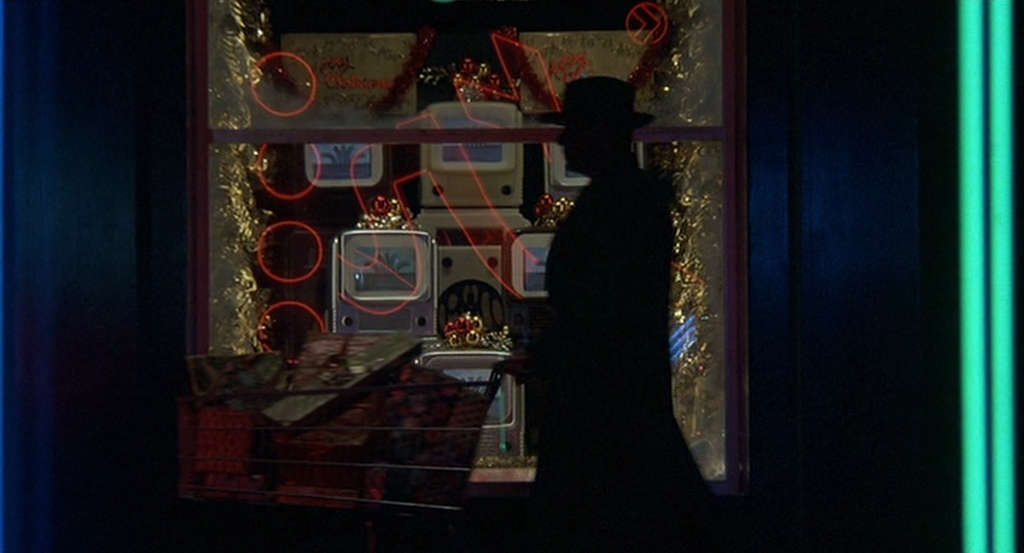
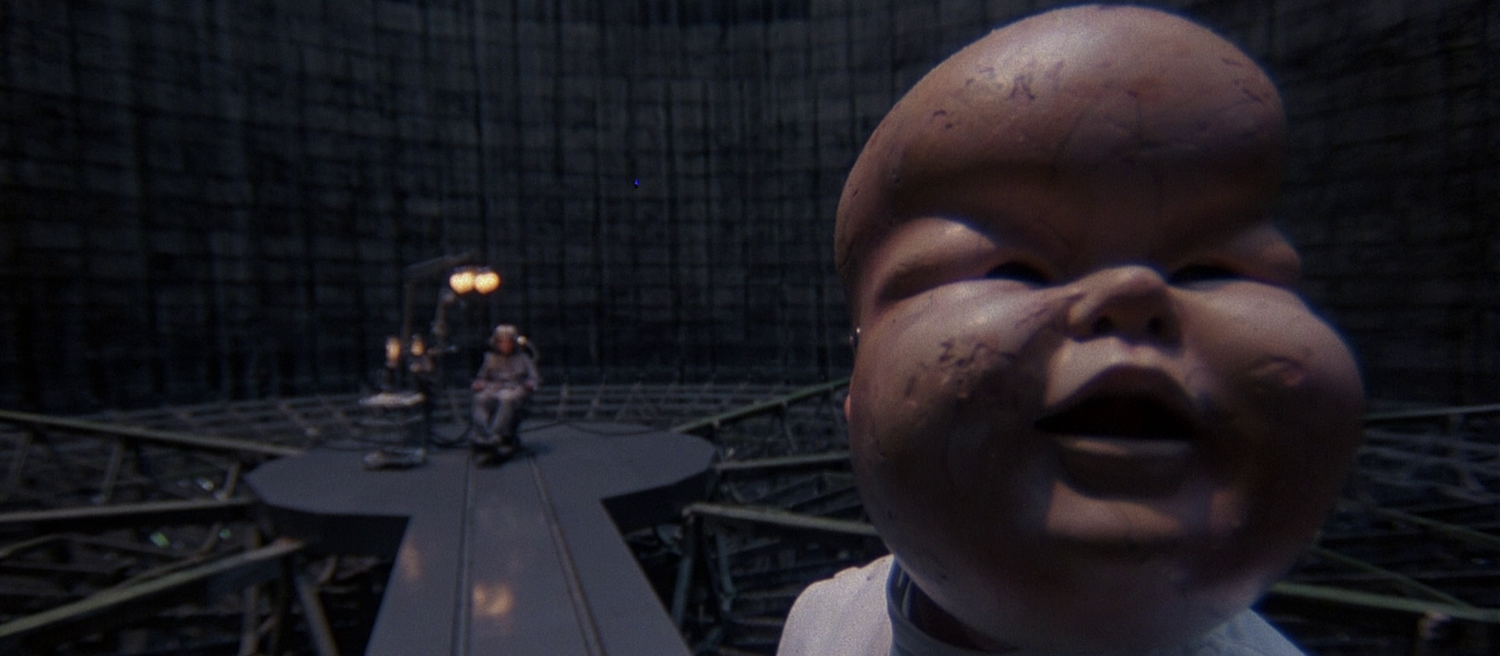
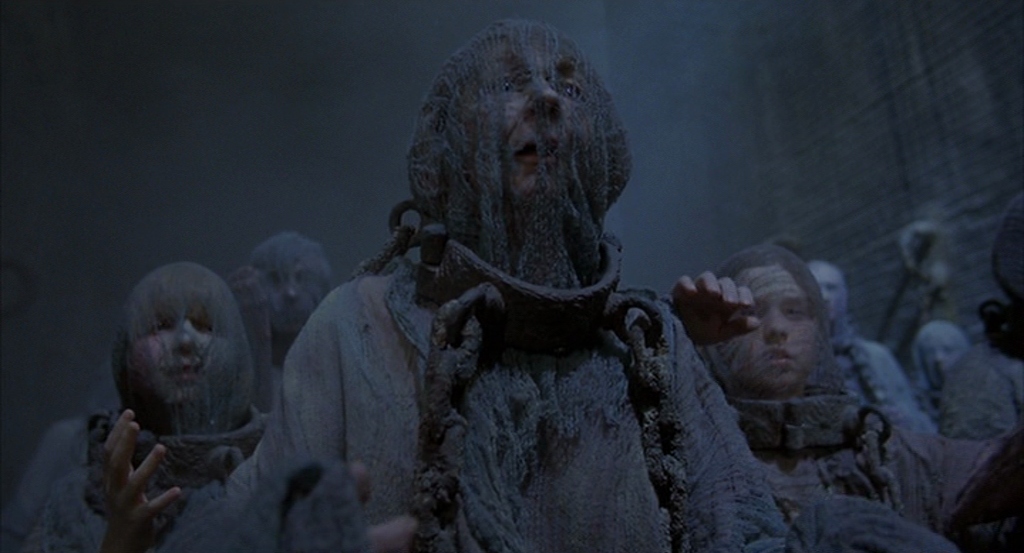
All of this is backdropped by a world bustling with uncanny life and wit. Gilliam is notoriously detail-oriented and often gets hung up on the smallest things at the risk of halting the entire production. In the case of Brazil, his fussiness pays off marvelously. The production design achieves a unique look with its tactile compositions of grimy junk and material excess. The grim sets are illuminated in an extreme style that calls to mind the hallmarks of German Expressionism with a strong hint of 1940s noir. Steampunk is crossed with magical dream sequences. All of it is dressed up with outlandish set design, delicious practical effects, and eccentric constumes. These bold artistic choices, when coupled with Gilliam’s use of wide-angle lenses, canted frames, and nightmarish lighting, produces a singular visual aesthetic that places us adjacent to the real world, as if seen in the reflection of a funhouse mirror. It’s always enjoyable to uncover new connections between films and upon watching Brazil in close proximity to Batman (1989) and The City of Lost Children (1995), the effect that Gilliam’s film had on Tim Burton, Marc Caro, and Jean-Pierre Jeunet’s visual styles is undeniable.
There’s so much happening on the margins of Brazil, each nook packed so tightly with colorful detail, that it overflows, producing one of those untamed beasts that live and breathe and always have something more to give. Among other things, it’s a love letter to the unpredictability of the human spirit, an excoriation of the feckless systems that try to bridle it, and an encouragement to fight for the freedom to live, dream, and dissent as you please. It thrives in its weirdness and is a resounding testament to the merits of creative freedom in the cinematic medium. It is a wild triumph, the work of an ingenious madman at the height of his powers.