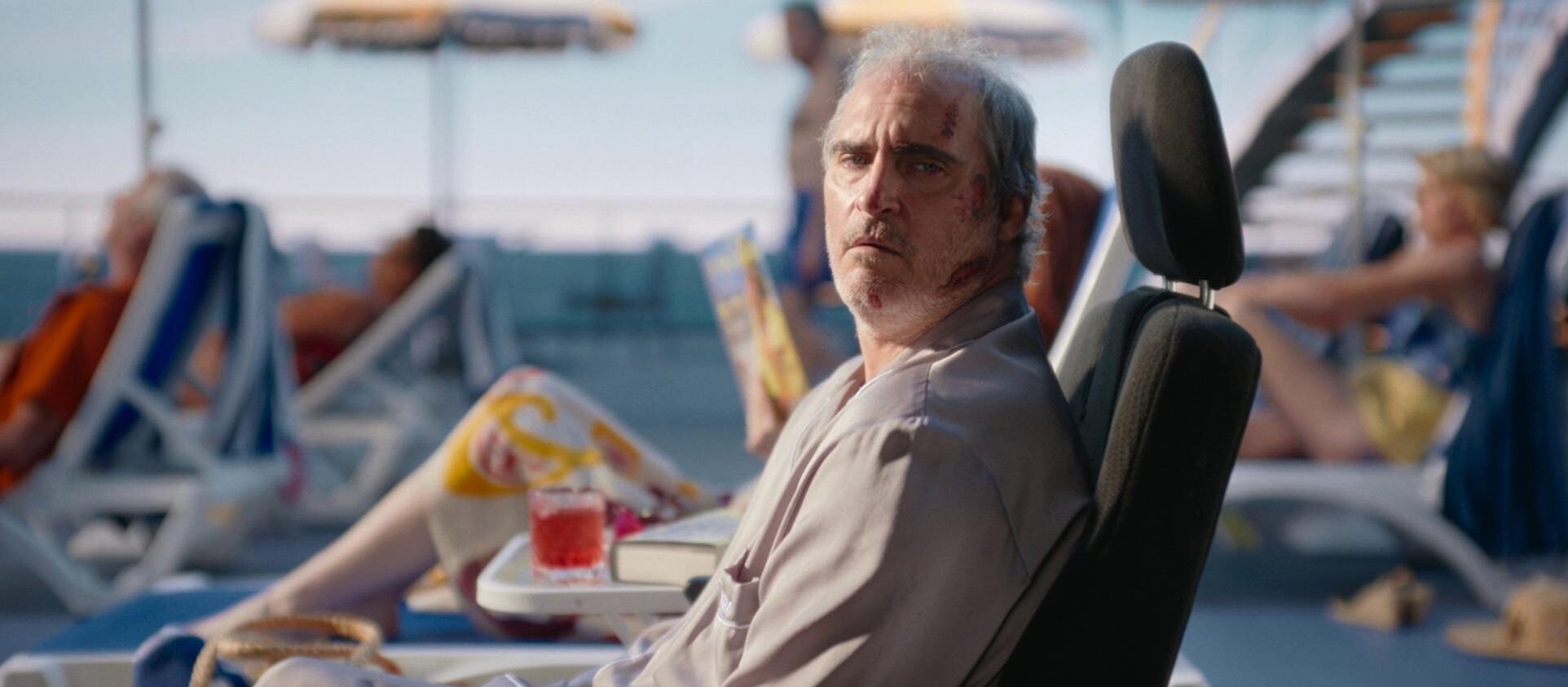

“That wasn’t a dream, it was a memory.”
With Beau Is Afraid, critical darling Ari Aster (Hereditary [2018], Midsommar [2019]) mistakes amplitude for creative insight, inflating a slender conceit about childhood trauma into a three-hour pageant of middle-aged humiliation.
Joaquin Phoenix, an expert at trembling, recoiling, and yelping, gives form to Beau’s neurotic, paranoid worldview, stumbling and shouting his way slump-shouldered and spineless through a grungy liberal city cast as a Boschian house of horrors, full of face-tattooed freaks and maniac addicts and kids with AK-47s and trigger-happy cops and rotting corpses. As the surreal odyssey proceeds—Beau is pumped full of drugs by his therapist (Stephen McKinley Henderson), is blindsided by a phone call that leads him to believe his mother (Patti LuPone) has been decapitated, is attacked by a serial killer, is adopted by a surrogate family (Nathan Lane, Amy Ryan), joins a theater troupe rehearsing in the wilderness, is tased, hitchhikes across the country, meets his presumed dead father who is actually a giant sentient penis, and is finally brought before a sea cave tribunal—the film’s imagination turns repetitive and, through its persistent theatrical grotesquerie, precludes any sense of revelation.
Aster’s previous features, whatever their excesses or miscalculations, at least disciplined their hysteria into a workable narrative shape, whereas Beau Is Afraid scans as if Aster’s creative liberty, earned through his prior successes, simply meant the self-indulgent first draft of his screenplay was rubber-stamped for production. It’s not that a non sequitur, surreal, arthouse horror-comedy is unreasonable—Scorsese’s After Hours (1985) comes to mind—but a shapeless and contrived three hours pushes the limits for a palatable one. There has been a critical tendency to assume a rich depth beneath the surface-level insanity, but it’s actually pretty simple. Indeed, it is conveyed entirely from the subjective perspective of an exceedingly one-dimensional character, albeit one afflicted with anxieties that allow Aster to wantonly dish out visceral, degrading punishments. I was half-expecting Beau to finally break the fourth wall and confront Aster à la Duck Amuck (1953), in which Daffy Duck realizes that the mischievous animator orchestrating this series of indignities is none other than Bugs Bunny.
Its tediousness is tempered somewhat by a mid-film stop-motion sequence overseen by Cristobal León & Joaquín Cociña, the filmmakers responsible for the unsettling The Wolf House (2018), as well as a brief turn from Parker Posey as Beau’s grownup childhood sweetheart, though Aster slathers the scene with sadism. I guess some people are into that.