
“You talk about that mountain like it was a real woman.”
“She’s been a lot better to me than any woman I ever knew.”
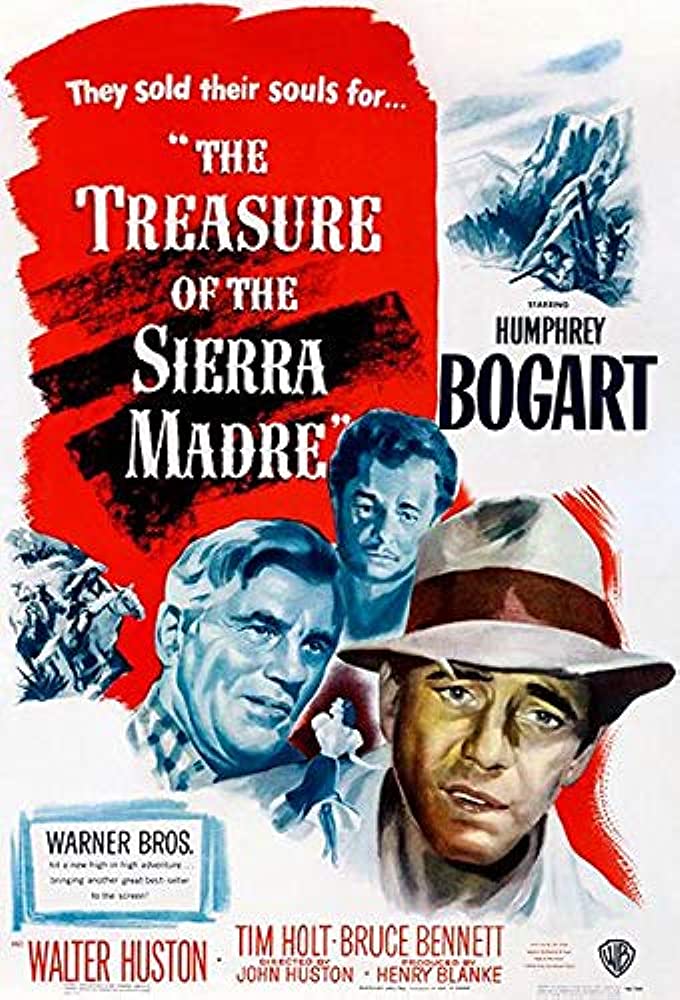
The Humphrey Bogart I’m most familiar with is the jaded hero of films like Casablanca and The Big Sleep. Early in his career, though, he made a living playing rough-edged gangsters and inmates, and he proves just as adept at playing the shifty loose cannon as the suave cynic. In John Huston’s The Treasure of the Sierra Madre, adapted from B. Traven’s novel of the same name, he plays Fred C. Dobbs, a penniless American panhandling in Mexico who teams up with a fellow vagrant Curtin (Tim Holt) and a canny, loquacious, bilingual old-timer Howard (Walter Huston, the director’s father) to try their hand at gold prospecting. Huston, who wrote as well as directed the film and fought with the studio to film on location (giving the film a gritty texture crucial to its drama), deliberately depicts Dobbs’ ambiguous morality in the early going, suggesting an inconsistent code of ethics in his dealings with a wealthy benefactor (a John Huston cameo), a pestering child selling lottery tickets (Robert Blake), and a dishonest construction foreman (Barton MacLane). Curtin, too, makes choices throughout that suggest his decision-making is based as much on the situation at hand as on principle. Consider the scene in which he contemplates leaving Dobbs in the caved-in mine. In this way, the mounting temptations that grow alongside the horde of gold feel entirely organic. When the trio is forced to deal with brief appearances from banditos (led by Alfonso Bedoya), natives, and a fellow prospector (Bruce Bennett), the audience is never quite sure how the situation will unfold. Thus the monomaniacal, paranoid drama is well-earned, and the various turns of events retain elements of surprise and irony.