“There’s nothing left alive but a pair of glassy eyes.”
Perusing one musical index or another, you’ll sometimes find that Raw Power won’t appear next to The Stooges (1969) and Fun House (1970), for the very simple reason that after their second album The Stooges broke up, David Bowie convinced Iggy to sign with Columbia Records as a solo act and move to England to make an album, and thus Iggy traveled to England with James Williamson (who had toured with The Stooges as a second guitarist) and began cooking up some killer rock ‘n’ roll tunes, only to discover that apparently no one in England could play drums and bass the way he liked, so he called up his old pals Ron and Scott Asheton AKA Stooges 2 and 3, with Ron graciously moving from lead guitar to bass while former bassist Dave Alexander slowly drank himself to death, and, maybe owing to the solo act deal, this slightly rejiggered lineup was dubbed Iggy & The Stooges. And so it’s filed under I instead of S, and Iggy Pop encourages listeners to “dance to the beat of the living dead” because this is a resurrected and altogether different version of the band.
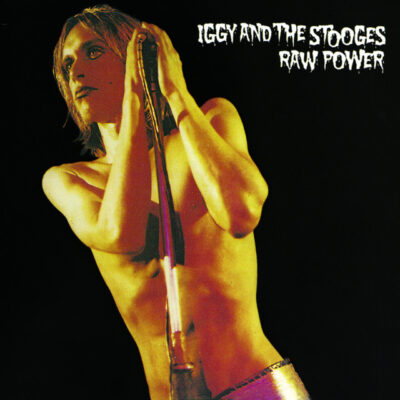
Another important background detail on Raw Power is that Iggy Pop tried to produce it in a rushed session, totally botching it, after which it was handed to Bowie, who by some accounts made it worse. In 1997 the original master tapes resurfaced and Iggy spent his good old time tinkering around with it. Both mixes have their proponents and bemoaners, with some preferring the cleaner sound of Iggy’s update but others preferring the muffled texture of the original. The original certainly has more of a DIY/feral/punk/sleazy/dirty/sweaty feel to it, while the 1997 mix is crisper and places Iggy’s vocal front and center. For students of the game it’s academically interesting to compare them, but there’s no shame in grabbing the ubiquitous 1997 mix if it’s available. But feel free to seek out the original vinyl pressing if you really want the 12-inch shirtless Iggy staring back at you from your record shelf to be vintage.
No matter how you listen to it, Raw Power is impeccable. The arrangements are revealed to be thoughtful and sophisticated to a degree that not even the grooviest and most complex songs on previous efforts could ever be accused of. There are savage riffs, tasteful solos, changes in tempo, elegant inclusions of acoustic guitar, celesta, piano, and tambourine. Ron Asheton was more of a bruiser on lead guitar, with subtleties to his riffs and tones that allow the listener to read into his playing a certain attitude that defines The Stooges’ ethos and droning, dreadful sound; but one would hardly count him among the all-time greats. To be fair, I don’t know if one would do that with Williamson either, but his arsenal is much wider and deeper than Asheton’s—lots of fuzz, of course, but diverse tones, strong melodies, catchy riffs, and a shifty compositional style that slides easily between glam, punk, blues, psychedelia, and rock. More so than Asheton, he’s a guitarist for the aspiring player to emulate. For what it’s worth, you can barely hear or feel Asheton’s bass on Raw Power.
Iggy Pop, for his part, has upped his game to match. One needn’t hear him croon about being bored on The Stooges to know he was bored, or that he was horny and hankering for drugs on Fun House to know he was horny and hankering for drugs; and those aspects of his persona were crucial to the band’s aura as countercultural/antisocial rebel figures. But they were not always pleasant to listen to. On Raw Power, though, he sounds incredible and displays a heretofore seldom-glimpsed range—he’s always had the screeching down to a science, but listen for the ominous croon on ‘Gimme Danger,’ the staccato yelping on ‘Shake Appeal,’ the sinister whisper-growl on ‘Penetration.’ And check out his improved lyricism as well. “Can I come over tonight? What do you think I wanna do? That’s right,” is replaced with “I’m a street-walkin’ cheetah with a heart full of napalm. I’m the runaway son of a nuclear A-bomb.” Whoo! Not exactly sure what it means but it’s a heck of a lot more artistically valid than what he was conjuring up in prior times.
If Fun House captures the spirit of the band at their most devilish and thus makes room for some individual clunkers in order to establish an overall mood, Raw Power just blasts you right in the face eight times; eight great hard rock ‘n’ roll songs.
Favorite Tracks: Search and Destroy; Gimme Danger; Raw Power; Shake Appeal.