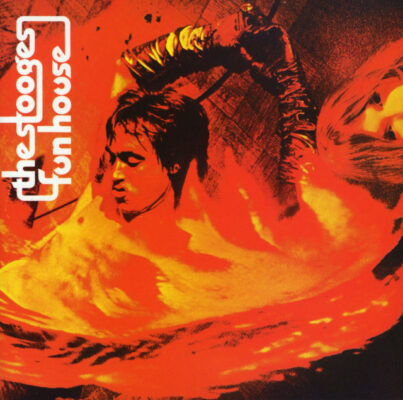
“I came to play and I mean to play around.”
It’s amazing what difference a year can make. The Stooges (1969) has its proponents, but outside of its staples, it’s quite top-heavy and repetitive. I’m not one to hold to the common adage that the band didn’t know how to play their instruments on their debut, but before the first chorus of ‘Down on the Street’ hits, it is evident that they’ve improved by leaps and bounds. They are more in sync and swaggering, flush with adrenaline; a confident unit with artistic intent, looking to kickstart a riot with their ferocity and defiant lack of refinement, where before they were a group of lackadaisical young dudes playing biffed up garage rock.
Much of this new sonic force stems from two major departures from the first record: 1) Ron Asheton’s guitar tones are drenched in reverb, with most of the tracks doubled with a cleaner tone to make them distinguishable; 2) Scott Asheton’s drumming has become extremely concise and groovy, upgrading from variations on the classic Bo Diddley beat to propulsive patterns inspired by Al Jackson of Booker T. & the M.G.’s or James Brown stickman Clyde Stubblefield. The bass work from Dave Alexander shows a similar increase in skill and sophistication. Indeed, these musical refinements, these hints and traces of psychedelia, blues, funk, soul, and jazz, are what get The Stooges slapped with the proto-punk label.
There’s also a more cohesive feel to the album as a complete work instead of just a couple ripping singles followed by junk; even as the songs themselves often defy any sense of conventional structure, the album builds in intensity until it more or less implodes. Fun House avoids toppling from top-heaviness by—imagine this!—having an entire album of worthy material. Or, well, maybe that’s not quite the right way to put it. There are only seven tunes here, and some are killer—the buzzsaw R&B of ‘Down on the Street’ is similarly conjured on ‘Loose,’ and ‘TV Eye.’ Side A concludes on a calm note with ‘Dirt’ before Iggy Pop’s strutting and screeching recommences with ‘1970,’ though now he’s in a sparring match with a howling saxophone (Steven Mackay) that arrives and stays the course for both the raw blues rock of ‘Fun House’ and musical chaos of ‘L.A. Blues.’ That cacophonous closer is even less decipherable and palatable than ‘We Will Fall’ from the first album, but at least it shares an attitude with the rest of the album, which is defined less by its songs than by the blasé, troglodyte vim and vigor that infects each track; the aggressive walls of reverb and nasty growls from Iggy Pop make these comparatively sharp performances feel even more raw and live-wire than the debut. You can hardly understand the lyrics most of the time, but if they were anything but prurient sleaze they wouldn’t fit the music.
‘I Wanna Be Your Dog’ was really the only song on The Stooges that felt truly charged with menace and set the band apart from the likes of the more artistically postured bands like The Doors and The Velvet Underground. Otherwise John Cale seemed bent on making the band less threatening on record than they reportedly were on stage. Don Gallucci seems intent on the opposite—to give their studio output the same visceral intensity of their live act. No clipping of the wings to make them sound more commercially acceptable. Listening to ‘I Wanna Be Your Dog’ felt like you had stumbled upon some filthy miscreants loitering out on the urban hinterlands, waiting for you, the unwitting passerby, to commence their primitive, primal rock ‘n’ roll ceremony; Fun House is a whole album of that abrasive pandemonium that actualized the claims that rock ‘n’ roll was the devil’s music. As crystal-clear a death knell of the utopian-minded 1960s as anything.
Favorite Tracks: Down on the Street; Loose; T.V. Eye; 1970.