
“The harder you beat a man, the taller he stands.”
Memory has a way of playing tricks on us, but if it serves me correctly here, Far Cry 2 is the only videogame I ever pre-ordered. I bought a handful of games brand new upon release (Banjo Kazooie: Nuts & Bolts, Halo: Combat Evolved Anniversary, The Lord of the Rings: Conquest), but I usually waited until my hard-earned birthday card money could get me three or four games for the price of one new one. (And these days I buy 10-20 year old games). So for me to work up the gumption to plop down sixty buckaroos meant I was pretty excited about it.
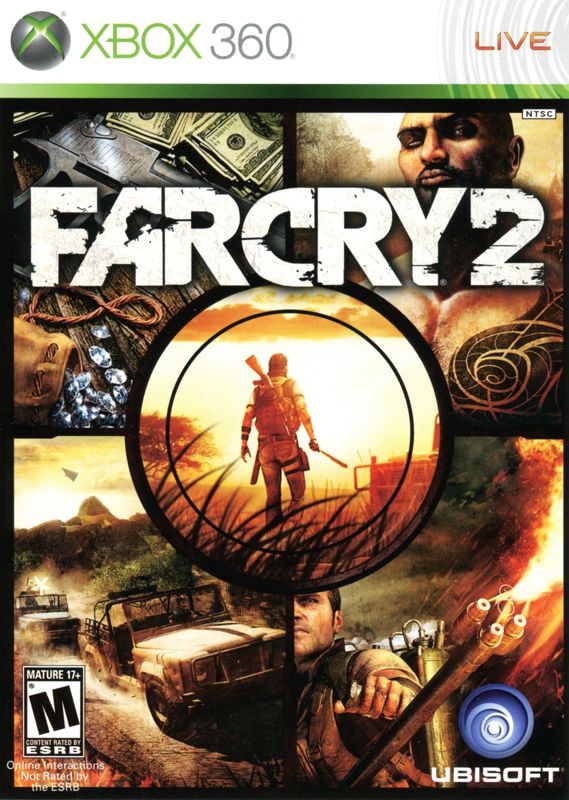
Anyway, Far Cry 2 is an odd duck—a sequel to the original Far Cry rather than its increasingly outlandish offshoots (Far Cry Instincts and Evolution) that, contrary to the campy tropical rampage of the inaugural title, tries to implement elements of realism as it explores a plausible conflict. Set in a fictional African state devastated by civil war, it casts the player as a mercenary who takes on a mission to track down and dispatch a notorious arms dealer who has been raking in profits by arming both sides. In this hostile realm, you must be a ruthless savage; by the end of the game you’ll have lost all pretense of heroism or righteousness as you are forced to embrace the wanton wickedness of this ravaged land.
In order to immerse the player in this horrible conflict, the development team at Ubisoft Montreal added a bunch of small tactile elements that significantly impact the way the game is played. Unusual for an FPS at the time, players will see their character’s limbs as they interact with the environment: opening doors, fixing vehicles, referencing the tattered map, and removing shrapnel from their own bodies. Fires spread across the arid scrubland according to erratic wind patterns, dust storms sweep the landscape. Day and night cycles dictate tactics. Malaria flare-ups or jammed weapons can disrupt firefights without warning. Fast-traveling is basically nonexistent, so you’ll mostly traverse the huge map by walking and driving. (And anyway, how is a bus system operating when hostile enemies will take potshots at you as soon as you step out of the designated safe zones?) Once you meet and make friends with a handful of other mercenaries, they’ll step in and fight alongside you when the going gets tough, even sacrificing themselves to keep you alive. All of these small inclusions feed right into the game’s core idea, which is to have unique, unscripted combat scenarios emerge naturally, with minimal intervention (few NPCs, limited HUD, scant cutscenes). Thus they retain the capacity to surprise and encourage unorthodox tactics. Regardless of what else it does or does not do, Far Cry 2 certainly makes excellent use of the videogame medium’s unique facets for adaptive storytelling, not merely telling the player they are isolated and alone in a hostile foreign environment but carefully crafting their experience so that they actually feel that reality while playing.
But even as they provide a sense of gritty realism—which lends weight to the game’s theme of the West’s exploitation of Africa—all the cumbersome extracurriculars do tend to create a heavy burden for the player. In terms of game design and narrative it is resolutely uncompromising. The very rhythms of the game emphasize the dog-eat-dog nature of the third world conflict it portrays, where every operator is either in it for themselves or a hapless victim of larger forces. Aside from these intentional hindrances, the game feels unrefined in other areas (combat, mission structure, enemy respawns), which further alienate the player and make the game feel less like an escapist open world survival-shooter than an increasingly onerous chore, one that gradually sucks the fun out of its repetitive formula. This friction is effective precisely because it is so exhausting, but what makes for a compelling simulation of a miserable existence doesn’t necessarily make for a thoroughly enjoyable videogame. Which is possibly a salient meta point for a game about mercilessly exploiting a third world country for personal gain. For what good will it do a person if he gains the whole world, but forfeits his soul?