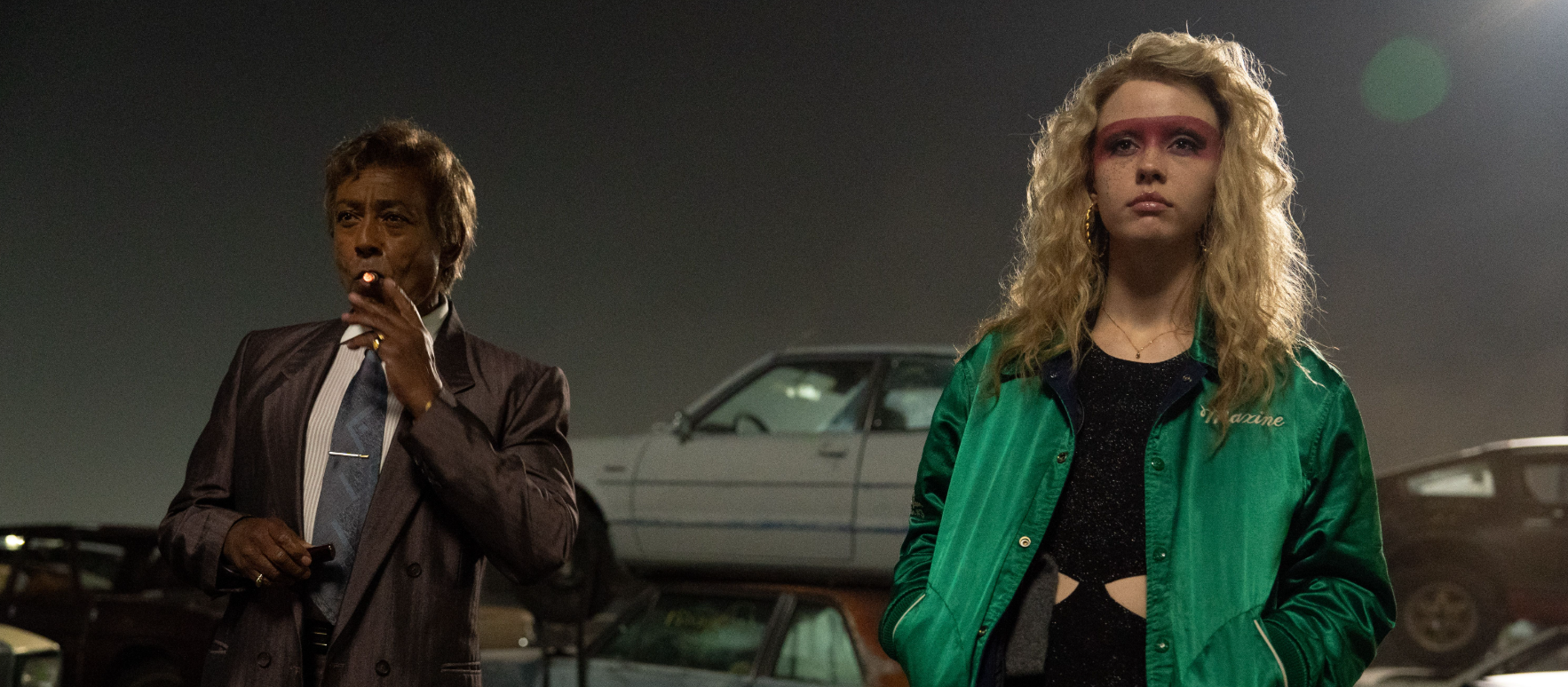

“I’ll organize the pizza and champagne for America’s newest scream queen.”
MaXXXine, the third and most perfunctory chapter of Ti West’s art trash homage to the horror genres of yore, ditches the hillbilly contexts of X (2022) and Pearl (2022) for the hedonistic setting of 1985 Los Angeles. As the Night Stalker murders unfold, Maxine Minx (Mia Goth) is plying her trade—making skin flicks, working as a showgirl, snorting cocaine, and auditioning for legitimate films; legitimate films, of course, meaning exploitation horror movies. She finally gets a break in a low-budget sequel helmed by an imposing director (Elizabeth Debicki) who, like West, wants to take the B-movie to new heights. But just as she seems on the cusp of achieving her dream to be famous at any cost, things go haywire. Videotapes of her activity are anonymously left at her door, Caché (2005) style. A serial killer begins targeting her red light district pals (Moses Sumney, Halsey, Chloe Farnworth). Two quarrelsome detectives (Bobby Cannavale, Michelle Monaghan) start pestering her. A slimy private eye (Kevin Bacon, magnificent as always when he plays comic relief) begins menacing her. Her lawyer/agent (Giancarlo Esposito) proves unhelpful. Anyone and everyone might be stalking and conspiring, and yet everyone in this town that says a porn star can’t become a movie star recognizes Maxine for her body (of work), so what is a girl to do? Alas, Maxine—previously established as a self-possessed go-getter—becomes reactive, a passenger along for the ride, which suits neither her character nor Goth’s talents for extreme characterizations.
The ingredients are here for a great film along the lines of Hardcore (1979) or Body Double (1984). Although West has the visual style and eye for detail to make a colorful thriller in the mold of De Palma, he gets so distracted by his ambition to reconfigure ‘80s junk into a commentary on modern times that the procession of sleazy tropes, textual and subtextual film references, and self-aware story turns becomes too heavy for the basic framework to uphold. It’s still viable as a sleazy serial killer movie (the very thing it sought to elevate) and is eminently entertaining for its first two acts, but the performative gestures of its grisly climax ring hollow as the film reiterates the weakest themes of X and takes the least subversive path. It’s hard not to measure this against Once Upon a Time in Hollywood (2019)—considering all the shared locations and the similarities between West’s and Tarantino’s styles and tendencies—and see a much lesser film.