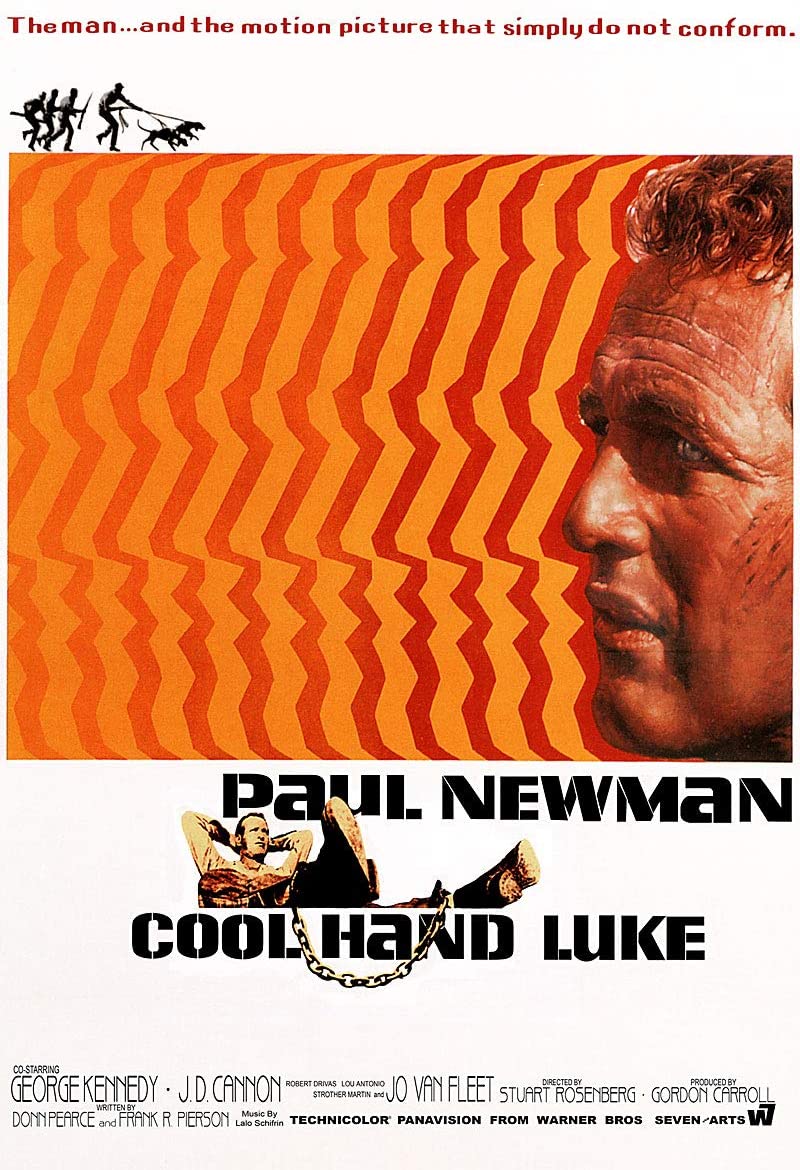
“You wild, beautiful thing. You crazy handful of nothin’.”
There is an iconic moment midway through Cool Hand Luke that seems like it should be incongruous, but somehow fits perfectly. After being arrested for drunkenly sawing off the heads of parking meters in the dead of night, decorated war veteran Luke Jackson (Paul Newman) is sentenced to two years on a chain gang repairing and maintaining the state’s endless spider web of highways and byways. Although his lack of respect for the established pecking order initially agitates the irascible Dragline (George Kennedy), he quickly earns the respect and admiration of his fellow inmates with his independent spirit, tenacity, and contagious smile. After getting walloped by Dragline in a backyard boxing match, bluffing his way to a win at poker, and leading the crew to complete an improbable paving job in record time, Luke becomes idolized by the other prisoners. As he sits on his bunk, high on the adulation of his compatriots, he basks in his newfound status as the resident golden boy. Glorying in the attention, he impulsively makes a claim of mythic proportions. “I can eat fifty eggs,” he says. “Yeah, but in how long?” someone replies. “An hour.” And so we’re treated to a lengthy montage in which Luke practices eating, trains with the dedication of a boxer, and then swallows fifty hardboiled eggs over the course of a tortuous sixty minutes. It’s a bizarre, memorable scene, inserted mid-stack in a macho prison drama that is by turns light and dark, playful and mean, funny and sinister.
There are occasional moments of catharsis to be found, but the film is brimming with physical and psychological suffering for our recalcitrant protagonist. Even though he’s only been sentenced to two years of hard labor, prison life quickly grates on Luke’s easy-going personality. Under the watchful gaze of the stern Captain (Strother Martin), Boss Paul (Luke Askew), and Boss Godfrey (Morgan Woodward)—known as the Man with No Eyes for his taciturn demeanor and mirrored sunglass lenses—Luke is pushed to desperate escape attempts. These forays into the countryside are improvised and short-lived and always invoke the wrath of the overseers, locking him into a downward-spiraling feedback loop. He spends extensive time in solitary confinement, yells at a God he barely believes in, and endures the news of his mother’s passing. As he audaciously tries to free himself from the confines of the prison system, his punishments worsen; but on each successive attempt he is held in higher esteem by the other inmates. Driven to a kind of mania by his circumstances, Luke’s escape efforts culminate in a last ditch attempt that finds him in a derelict church confronting God and, after a fruitless conversation, the guards as well.

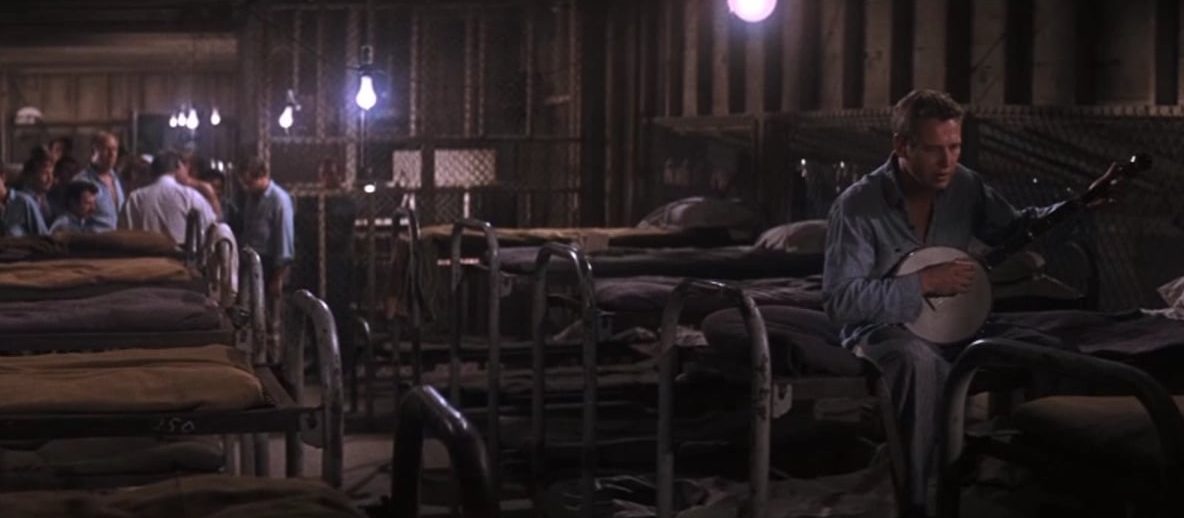
In the end, Luke becomes a willing martyr, objecting to the violence in the world by intentionally succumbing to it. His death aligns with several other overt references to the crucifixion of Jesus—after downing fifty eggs, he lies on his back on the table, arms outstretched and legs crossed, in a posture resembling Christ on the cross; before he dies, he speaks to God like Jesus in the Garden of Gethsemane; and the film ends with a crossroads meant to represent the cross. I wouldn’t say there’s a strong allegory buried in here, but the somber yet hopeful meaning extracted from Christ’s death and resurrection informs the tone of Cool Hand Luke. In a curious moment that rivals the egg scene in terms of incongruity—and proximate to it in the film’s sequencing—Luke sits on his bunk cradling a banjo. He begins plucking some chords and then sings a melancholy rendition of ‘Plastic Jesus’—pausing for a moment to catch his breath before launching into the second stanza again with increased vigor. A song about placing one’s hope in Jesus seems appropriate for the wistful moment. But despite its religious language, ‘Plastic Jesus’ is actually a comedy song, written as a spoof advertisement for dashboard figurines by two folk singers in the 1960s. Taught how to play the banjo from scratch by Harry Dean Stanton (who plays ‘No Grave Gonna Keep My Body Down’ while Luke digs trenches as punishment), Paul Newman’s raw performance is shown in a single take, flubs and awkward pauses and all. Newman even manages a tear. It’s another bold inclusion that blends seamlessly with the whole.
I don’t care if it rains or freezes,
Long as I got my plastic Jesus
Sittin’ on the dashboard of my car.
Comes in colors, pink and pleasant,
Glows in the dark, ‘cause it’s iridescent.
Take it with you when you travel far.Get yourself a sweet Madonna,
Dressed in rhinestone, settin’ on a
Pedestal of Abalone Shells.
Goin’ 90, I ain’t scary,
‘Cause I got the Virgin Mary
Assuring me that I won’t go to hell.
Director Stuart Rosenberg and cinematographer Conrad Hall expertly evoke a sense of place by highlighting the harsh climate of the countryside: shirts sticky with sweat, dust that clings to every damp surface, and windows that are left open during rainstorms to allow for a breeze. Paul Newman and the rest of the cast actually resurfaced and cleared the shoulders of a mile of road themselves, adding a layer of authenticity to the production and helping to put the cast in the right mindset for their roles. Donn Pearce, who was adapting his own novel to the screen, sketches out the psychological ramifications of placing a bunch of men in a social order devoid of women. As the men clear brush from the roadside, a scantily clad, well-endowed farmgirl (Joy Harmon) provocatively washes her car, driving the men wild with hot-blooded lust as they behold a woman in the flesh for the first time since who knows when.
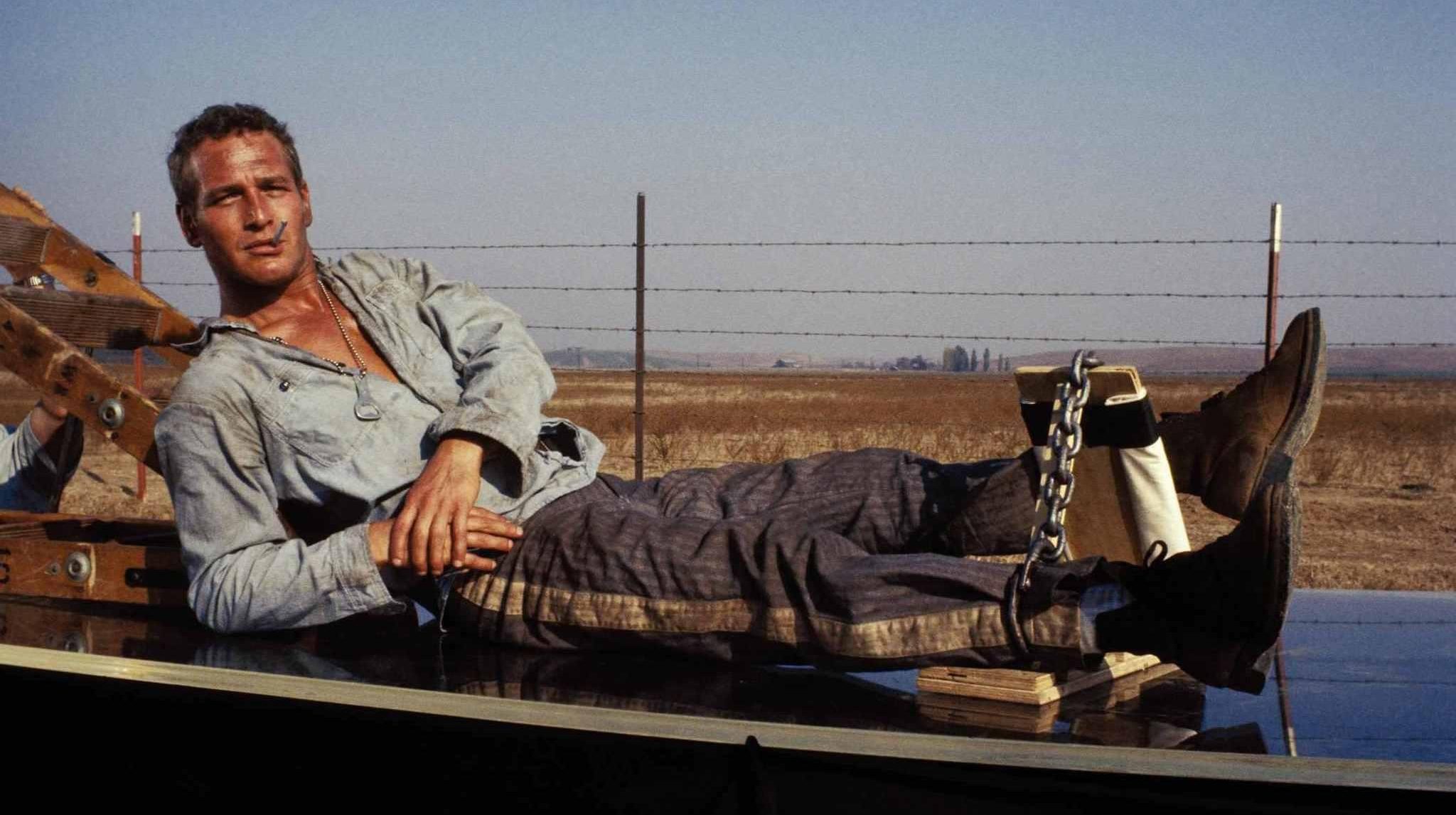
Newman’s carefree charisma is on full display here as he plays the unfazed sojourner coming to grips with his past. It’s impossible to overstate how crucial Newman’s camera presence is to the success of the film. He was nominated for Best Actor but lost to Rod Steiger (In the Heat of the Night [1967]). George Kennedy, however, won the Academy Award for Best Supporting Actor for his turn as Dragline. The rest of the cast, while featured less prominently, remains ardently committed to their roles, from inmates played by Harry Dean Stanton, Dennis Hopper, Joe Don Baker, and Anthony Zerbe to the trio of prominent prison officials. Strother Martin delivers the iconic line—later echoed by Luke as he mocks the Captain just before he is killed: “What we’ve got here is… failure to communicate.”
Caught between fatalism and hopefulness, the story of incarcerated brotherhood presented in Cool Hand Luke is elevated to classic status by two towering performances and a strong supporting cast. Packed with iconic scenes and powerful themes of existentialism and religious uncertainty, it captures the spirit of the rebellious 1960s counterculture (although it is rather tame and conventional compared to contemporary groundbreakers like Bonnie and Clyde [1967] and The Graduate [1967]). Even if one overlooks the philosophical underpinnings, mythic qualities, and religious symbolism, Cool Hand Luke is simply a downright entertaining movie.
Sources:
Forde, Sienna. “You Never Knew These Facts About Cool Hand Luke”. BrainSharper. 1 July 2019.