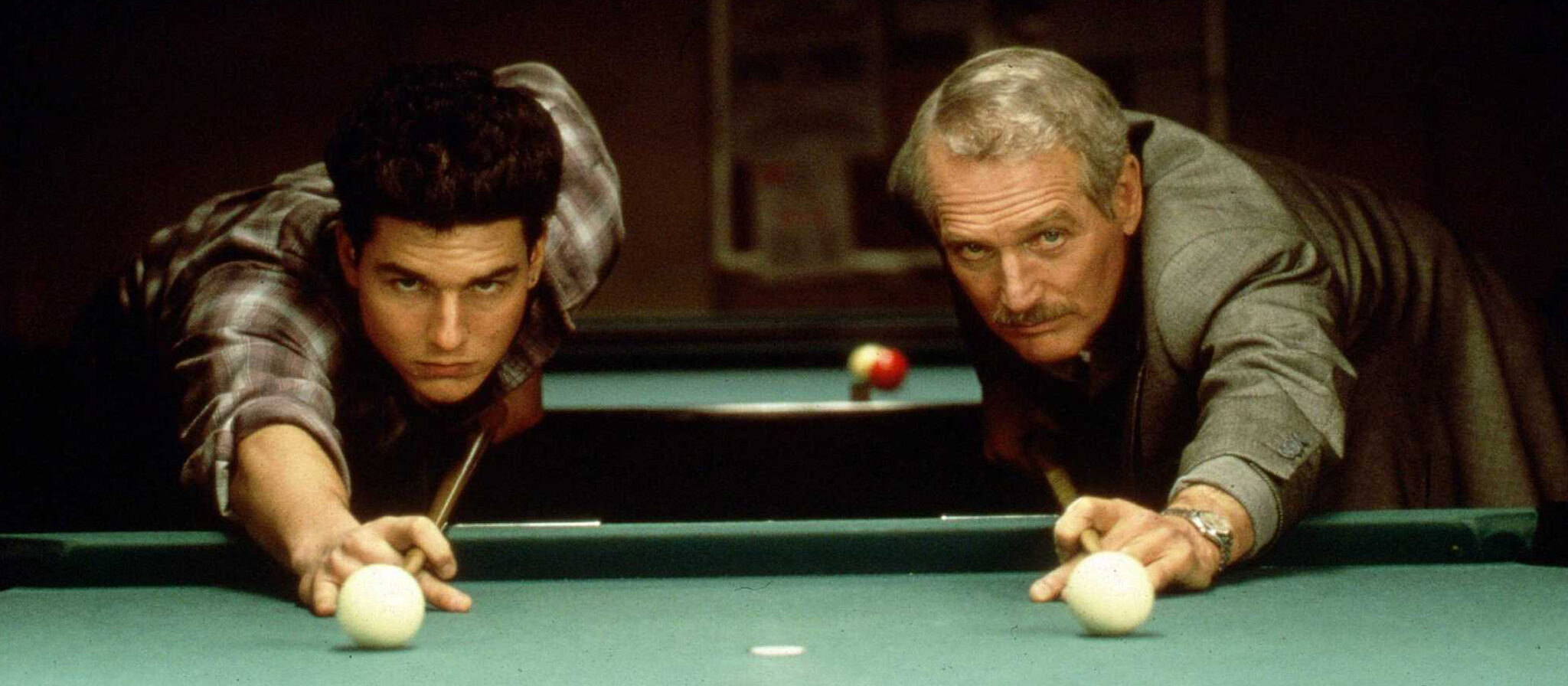

“You gotta have two things to win. You gotta have brains and you gotta have balls. Now, you got too much of one and not enough of the other.”
Though neither a top-tier Martin Scorsese film nor a totally worthy follow-up to The Hustler (1961), The Color of Money does enough with its three principal characters and its flashy presentation of nine-ball pool to at least warrant a footnote in the annals of the sports drama canon.
A quarter century after playing the brash young “Fast Eddie” Filson in Robert Rossen’s excellent 1961 film, Paul Newman reprises his role, now acting as a shrewd mentor to players like Julian (John Turturro). When Julian is convincingly beaten by the fresh-faced hotshot Vincent (Tom Cruise), Eddie decides to take the new talent under his wing. And so Eddie and Vincent hit the road, along with Vincent’s girlfriend Carmen (Mary Elizabeth Mastrantonio), conning their way through myriad small-town pool halls by feeling out the scene until the big money is thrown down against them, then going in for the score.
Soon, Vincent’s raw ability and cocksure attitude lead to a battle for dominance, eventually provoking the retired swindler to shape up and make a comeback—Eddie is a stand-in for author Walter Tevis, certainly, but possibly Scorsese and Newman as well. They see something in the up-and-comers that reminds them of themselves years ago, and the revelation commences all manner of inner turbulence.
There’s nothing at the end of The Hustler to suggest it needed a sequel, but with Scorsese, Newman, Mastrantonio, Cruise (showing some acting chops that he hasn’t always put to good use), and ace editor Thelma Schoonmaker working in tight unison, The Color of Money delivers an amiable but formulaic character drama. Among other highlights are a scene in which The Hustler gets hustled by a sneaky player (Forest Whitaker) and a brilliant arc shot that whips around the room as Cruise sinks his shots, dancing and singing along with Warren Zevon’s ‘Werewolves of London’. Oh, and there’s an Iggy Pop cameo too.
But if we consider John Cassavetes’ advice to Martin Scorsese upon a screening of Boxcar Bertha (1972)—paraphrased: focus on making films that no one else could make—The Color of Money doesn’t really fulfill that ambition in the way that even Scorsese’s less successful pictures do.