“Each of us finds his way, his place; we rattle around the universe until everything fits; this is life; this is science, or something better than science.”
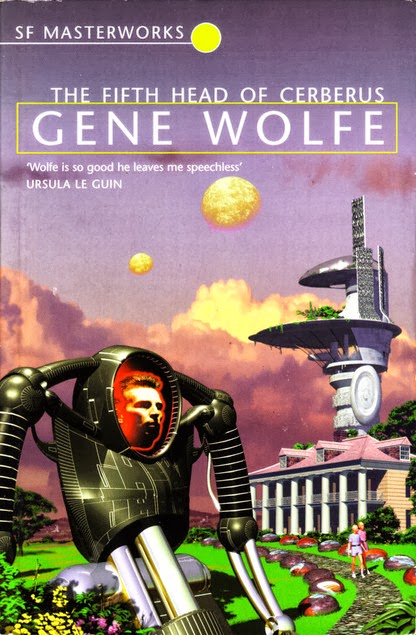
Gene Wolfe’s debut (his actual first novel, Operation Ares [1970], was retrospectively disowned by both the author and many fans) isn’t a novel at all—it’s three interconnected novellas that share characters and settings but not, crucially, a shared account of what actually happened. It’s like a science-fiction Rashomon (1950). As such, it’s a book meant to be read more than once, one that playfully chides the reader for trusting it to be straightforward the first time through. The stories unfold like sustained, haunted dreams—not the kind that frighten you awake, but the kind that tickle the edge of your subconscious and leave you certain that something momentous and ineffable happened.1
It is a wonderful, compact blitz of literary science fiction in which narrative, while engrossing as anything, brilliantly doubles as a framework for circling questions of colonialism, memory, childhood, spirituality, and identity that Wolfe would keep returning to for the rest of his career, in Peace (1975) and The Book of the New Sun (1980–1983) and beyond. Incredibly concise for the ideas and ruminations it contains, the book’s craftiness and refusal to explain itself leave the reader with a series of impressions to sift through after the clever mechanics of the plot have resolved. That’s not a flaw the book stumbles upon willy-nilly, but rather the whole design.
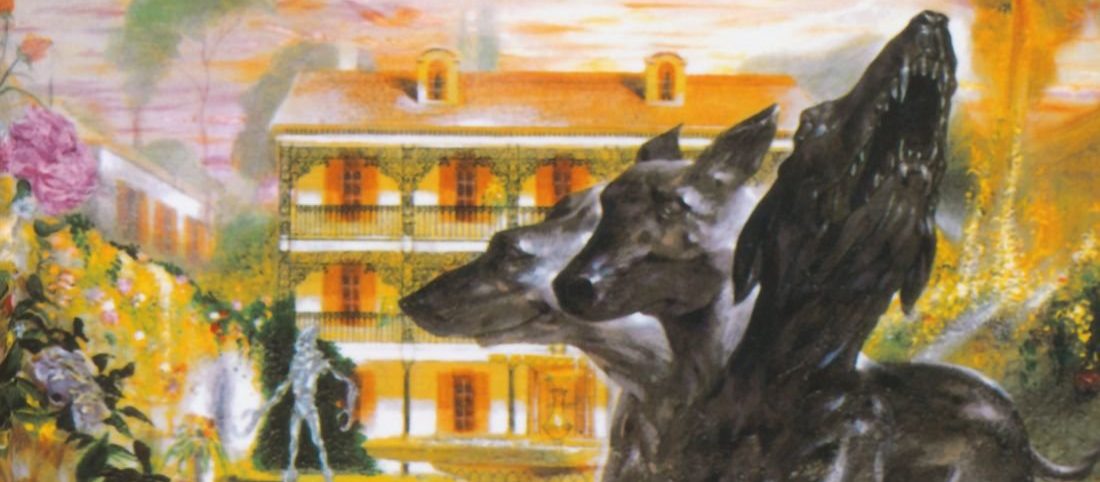
The Fifth Head of Cerberus is a slippery title before you even open the book. As Wolfe’s self-insert narrator eventually explains, Cerberus, the typically three-headed dog of Greek mythology, is, within the context of this story, metaphorically represented by the narrator’s own family: his father, his aunt, and his tutor Mr. Million form the dog’s three visible heads; his brother David is an unseen fourth head and, by implication, the narrator himself is the fifth. It’s a little puzzle but of course Wolfe is also alluding to more than just a five-headed monster, but a monster that guards the gates of the underworld.
The title novella is a gothic coming-of-age story about a boy raised in a brothel at 666 Saltimbanque Street in Port-Mimizon, on the settler world of Sainte Croix, which orbits the same sun as its twin planet, Sainte Anne. Like the mature Severian of The Book of the New Sun, the narrator is an adult reconstructing and dredging his childhood memories; one of Wolfe’s chief preoccupations is that this memory is not the same thing as a historical record, and indeed, the historical record might not be bona fide fact. The prose keeps sliding between three different versions of the same narrator: the omniscient adult who already knows how the story ends, the beleaguered present-tense young man still sorting through what happened to him, and the bewildered child who understood almost none of it in the moment. Wolfe never announces these switches, and in fact works quite diligently to obscure what is actually occurring, even while keeping it right there on the page. The effect is one of the ground subtly shifting beneath the reader’s feet; the after-effect is one of wonder and discovery as new layers unfold and hidden bits of ancillary plot bubble to the surface.
We meet the household gradually: the brother David; their tutor Mr. Million, whose nature is delivered to us in bits and pieces until it emerges that he’s a robot running on an unbounded scan of the boys’ great-grandfather’s mind, and who takes the boys to the library and the slave market and is generally responsible for their upbringing; their levitating Aunt Jeannine, who moonlights as the renowned anthropologist Aubrey Veil; and the boys’ father, Maitre, the brothel’s mad-scientist proprietor, who remains a genuinely frightening cipher for most of the book precisely because we only ever see him through a child’s fear of him. He is, notably, conducting decades-long experiments on his own bloodline. The horror of the novella is twofold, located not only in the grim reality of the family’s heritage of self-clones, but also in the mundane, sympathetic horror of a child trying to win the affections of a father who does not care to be worthy of them.
One night Maitre—a heretofore distant figure in the boys’ lives—has the boy brought to his study and subjects him to hypnosis, drugs, and a battery of psychological tests, at the end of which he’s christened “Number Five.” These sessions become routine. As his grip on what’s real starts to loosen, Number Five meets John Marsch, a visiting anthropologist from Earth chasing down the origin of Veil’s Hypothesis—the theory that the native inhabitants of Sainte Anne, the “abos,” mimicked the first human settlers so completely that they eventually replaced them outright—and then forgot. Marsch’s appearance is a hinge point for the entire story cycle. He appears as a character here, narrates the second novella, and becomes the subject of the third—three different versions of the same character filtered through three different, unreliable lenses.
When Number Five, David, and a slave girl break into a trader’s warehouse to steal money for a play they want to stage—a lot happens in this novella—they find a four-limbed slave whose face resembles Number Five’s own. In typical Wolfe fashion this is barely noted in passing, but it prompts the reader to circle back to an earlier segment in which Mr. Million drags the boys to the slave market and peers into the faces of many of them, before they’re allowed to go climb the spiralling staircase to the top of the library and peer out over the city. The slaves have been chemically and surgically altered until they’re barely human; Mr. Million seems to be looking for some slave(s) in particular; and the narrator just offhandedly remarks that he happens to look like one they found guarding some loot, who also has four arms and fights like a demon from hell. He expresses a desire to dissect it, as a specimen, like the small animals he’s been investigating, but the larger question—”What am I?”—remains unanswered because it’s unasked. But at least part of the answer is that he is his father’s son. Indeed, with Marsch’s help, Number Five eventually works out that he’s a clone of his father, a man who has spent his life trying to diagnose the reason for his family’s long intellectual and moral decline.
Wolfe uses a chess motif that’s easy to miss but hard to unsee once you catch it (but isn’t that Wolfe in a nutshell?)—we’re thrown of the scent by our grown-up narrator but we come to realize there are hidden depths to the world that he doesn’t grasp in the slightest, that we as readers strain to make sense of, and that we are hearing the story from a character who is, in the end, a pawn in a larger game which he doesn’t understand. There’s a version of this story where David—the “normal,” un-cloned son—narrates instead, and it would have been a much simpler one. Wolfe’s choice to give us the clone’s voice, split three ways across time, is the first of the book’s many decisions to make the harder, stranger version of the tale the only version we get.
The second novella, ‘“A Story,” by John V. Marsch,’ is the hardest to get through on a first pass, and Wolfe clearly means it to be. It’s told—or purports to be told—from inside the pre-contact culture of Sainte Anne, in a primitive-technology world rendered as a haze of hallucination, dream, and myth, following twin brothers, Sandwalker and Eastwind, whose separated lives converge again just as the first Terran ships arrive. It’s a mythic text and a feat of style, but of the three novellas it’s the one that risks losing the reader entirely: the unreliable narration, alien mindset, and structural ambiguity that make Wolfe’s writing so distinctive elsewhere are laid on overthick. Still, I’ve learned to give Wolfe the benefit of the doubt, and I see ‘A Story’ as his attempt to write from inside a culture that “Western/Terran” anthropology—embodied by Marsch, and, by extension, the reader—can only ever approach from the outside, with all the inevitable distortions of translation that stem from it.
Peter Wright, in his essay “Confounding the Skin and the Mask,” reads the abos’ capacity for mimicry as a kind of postcolonial threat: a native culture so good at reflecting the colonizer back at himself that it destabilizes the colonizer’s sense of his own authority and even his own reality. If the abos really did kill the first settlers and simply become them, then “civilization” on these twin worlds isn’t a triumph of science and progress at all. Even the novella’s title undercuts itself: it’s credited to Marsch, a man we’re never sure actually wrote it, about a people whose entire recorded history may be a fiction imposed on them from outside.
(The abos’ relationship to dreaming—the sense that the dream-world is at least as real as the waking one—has more than a passing resemblance to the Aboriginal Australian concept of Dreamtime, a connection that also surfaces in Peter Weir’s 1977 film The Last Wave.)
Sandwalker and Eastwind’s twinship is also the clearest statement in the book of a question that runs under all three novellas: if two beings share an origin—twins, or a clone and his original—what, if anything, makes them different people? The abos are said to reproduce by a kind of merging and splitting rather than conventional birth, which means the question of individual identity that torments Number Five in the first novella isn’t a symptom of his particularly strange upbringing. It gets into nature/nurture, the child is the father of the man type stuff.
The last of the stories (‘V.R.T.’) is not really a story at all; instead, we are presented with a series of disparate source materials—field journals, interrogation records, prison diary entries—that eventually sketch a disjointed, non-linear narrative for us. It’s the most experimental and ambitious of the three selections and is difficult to unravel and piece back together in a logical fashion. John Marsch, the anthropologist who appeared in the first story, and “wrote” the second one, has been (unjustly?) arrested and imprisoned on suspicion of espionage and assassination, and his file is being reviewed. The story overlaps with the first one, filling in details of the “abos” as Marsch explores Saint Anne. Hiring a half-aboriginal boy to guide him, Marsch travels deep into the countryside searching for full-blooded natives. At one point, the tone of Marsch’s journal entries changes, suggesting that Veil’s Hypothesis may be true.
This is where the book’s central gimmick becomes explicit rather than just implied: is the imprisoned man Marsch, or is he the abo guide—having taken Marsch’s place and, perhaps, his memories? This is resolved neither by the interrogators in the story nor Wolfe, which is the point. The record itself—the “evidence,” as it were—turns out to be exactly as unreliable as human memory. Taken together with the first novella’s hint that the narrator’s own surname might be Wolfe, the whole convoluted tale becomes Wolfe’s first artistic critique of the idea of the author as arbiter of truth in his fictional realm.
Taken as a whole, the trilogy is thematically dense, with its density made all the more challenging by the disagreement between its three parts. Each novella complicates or outright contradicts the version of events given by the others—what ‘V.R.T. tells you about the abos revises what ‘A Story’ implied, which in turn recasts what Number Five believed about his own household. Instead of building towards a revelatory synthesis, Wolfe builds three overlapping, incompatible maps of the same territory.
The most persistent question is personal identity—how we understand ourselves against our families, our history, our species. It’s not hard to hear an echo of the classic philosophical thought experiments about personal identity and continuity of self here; the ship of Theseus dressed up as a boy who may or may not be his own father. The second most interesting idea is the possibility that the abos really did wipe out the first settlers, took their shapes to survive, and over generations simply forgot they’d ever been anything else. Or maybe none of that happened, and the humans exterminated the abos exactly as the official history claims.
To be sure, Wolfe is not trying to convince us of anything, not on a plot level nor regarding themes. He isn’t investigating issues of identity, colonization, or cloning from a scientific or systematic perspective, so much as he is submerging himself and so the reader in the mysteries of the universe, provoking the reader to reflect upon their own perceptions of the world and how they were shaped. Why do we draw lines in the sand here instead of there? Why do we draw them at all? It may be hard to genuinely connect with the material on an emotional level due to its detached mode of storytelling, but the story cycle’s richly envisioned, multi-layered scenario, and Wolfe’s ability to unsettle with playful and obscure l language, make it terrifically meaningful.
There’s also some religious undercurrents running beneath the surface. Easy to miss, like the rest of it. We’ve already gotten a big hint from the Cerberus allusion. But I think we’re also meant to waver back and forth on the abos themselves, held as devils in the settlers’ sanctioned mythology but, in our closer encounters, revealed as something stranger and more ambiguous than that. There’s also—contra my previous claim of detached storytelling—an emotionally resonant and redemptive arc for Mr. Million, the robotic tutor built from a dead man’s mind; a machine slowly reopened to beauty and compassion. Even if the ghost inside him may well be that of the very man who set the whole cloning scheme in motion eons ago, even if as a computer he can’t really feel emotions the way humans can, it is Mr. Million who features in the book’s most humane storytelling.
Wolfe diligently writes in such a way that the reader can miss large chunks of what’s happening if they are not persistent in reading between the lines and following the subtle nuances of the writing. At times it can actually feel as if he is simply loading the reader up with a bunch of hints about the story without plainly telling us anything. His writing is simultaneously florid yet concise in its storytelling, while maintaining a certain poeticism and employing an expansive lexicon. All this makes The Fifth Head of Cerberus a challenging and perplexing read. It requires attention and persistence, maybe some rereading of certain passages (or, you know, the whole book). For fans of straight-up pulp science fiction, this may be impenetrable, but it might appeal to readers who generally scoff at the genre.
1. This happens to me about once a month. For instance, as an adult, I dreamed I was a child (though not myself as a child; just a child) riding a tricycle backwards up a hill. Flanking me on both sides were a half dozen exact clones of “myself,” smiling hideously at me. All motion abruptly ceased and some kind of narrator said, “Here is the final utterance, that the owner of this heart is dead and has been for some time.”
Sources:
Wright, Peter. “Confounding the Skin and the Mask: Gene Wolfe’s The Fifth Head of Cerberus and the Politics of Ambiguity”. Ultan’s Library. 15 January 2002.