“They say you’re a veritable phantasm.”
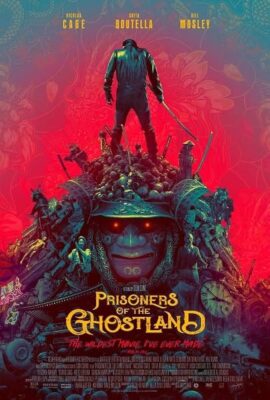
Mandy (2018) essentially maxed out the late stage Nic Cage goes berserk in a sci-fi/horror action movie formula, but that doesn’t stop Sion Sono from trying to replicate it and give it his own spin with Prisoners of the Ghostland. And though it’s awfully silly and doesn’t hold a candle to the deranged majesty of Panos Cosmatos’ freakshow, and the decision to not do a theatrical release was probably the correct one, it’s far from a bottom-of-the-barrel Cage project and is eminently watchable for its duration.
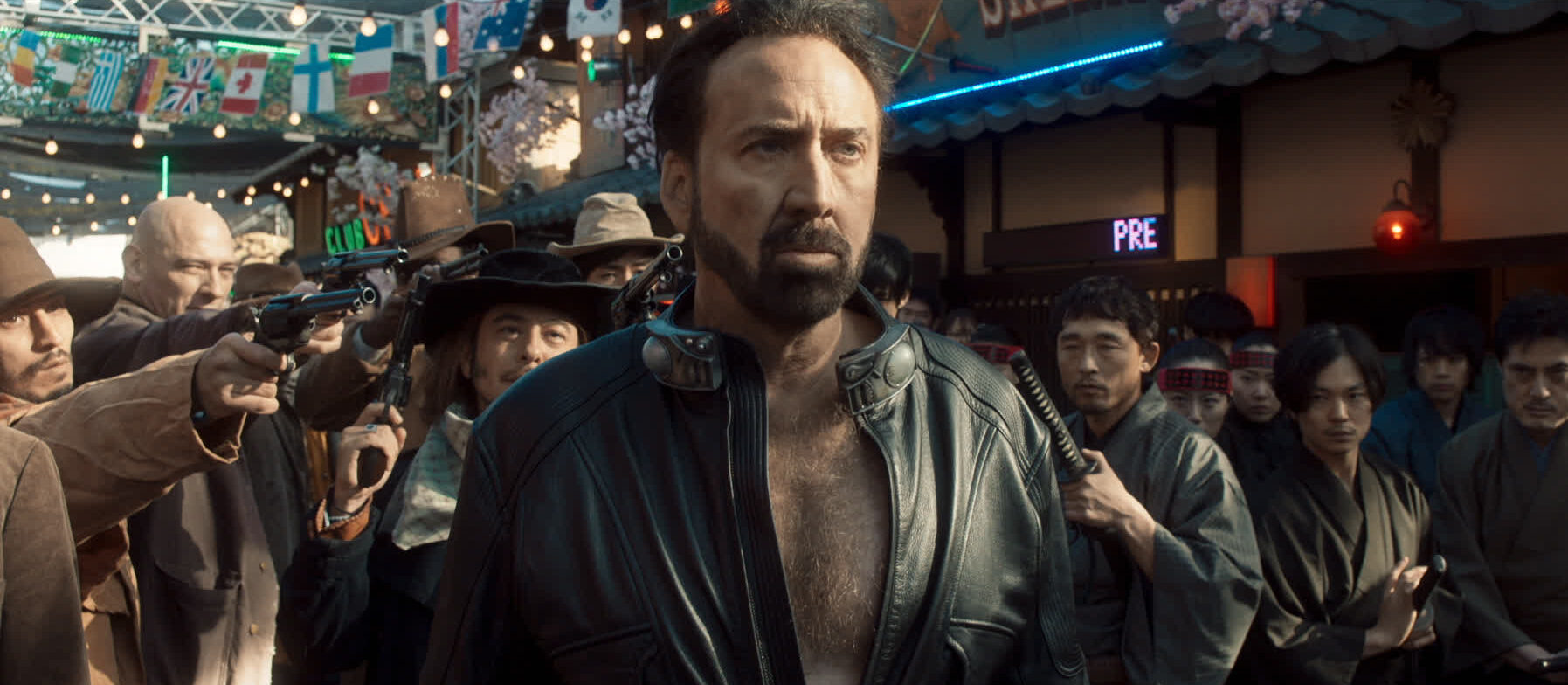
Cage (The Unbearable Weight of Massive Talent, Dream Scenario) stars as a nameless wanderer in the mold of Toshiro Mifune or Clint Eastwood, a charming, lethal rogue of uncertain loyalty. The setting, however, is anything but conventional. In a region of Japan devastated by a nuclear accident, a settlement called Samurai Town has sprung up, ruled by Bill Moseley (The Texas Chainsaw Massacre 2, Carnivàle) and his silent right-hand samurai Yasujiro (Tak Sakaguchi), combining various aspects of Japanese culture and the American Old West. Cage’s character is an outlaw who’s only been released from prison so that he can track down one of the Governor’s lost “granddaughters” (read: a harem of sex slaves). This particular granddaughter (Sofia Boutella) has snuck off into the irradiated and potentially supernatural realm known as the Ghostland. To ensure his compliance, he’s been equipped with a thought-reading explosive suit that will blow off his arms or his testicles if it senses he’s about to commit certain acts.
Not too dissimilar from Escape from New York (1981) or Hell Comes to Frogtown (1988) in terms of plot, but much different in tone. Where those films flash their genre weirdness right away and then romp through their scenarios, Prisoners of the Ghostland looks to confound the viewer at every step. Cage’s Nouveau Shamanic style of acting is a self-contained cabinet of curiosities, but there’s plenty going on outside of his performance that is designed to throw the audience of balance: townsfolk breaking out in song, inexplicable narrative elisions, unremarked upon non sequitur visual gags (at one point Cage rejects a sturdy wasteland buggy for an undersized bicycle), mysterious mannequin-esque costumes, elaborate set designs. At almost every point the film calls attention to its artifice with its Gilliamesque future junk aesthetics and group chants and stilted dialogue. Even Moseley’s showy role steals the spotlight from Cage on occasion.
After a while it all becomes a little too much, with the neon-lit streets and gory shootouts and histrionic parody overtaking the B-movie storyline as the film’s raison d’être. On the other hand, as soon as it stops upping the ante and reverts to standard pseudo-Western clichés for something akin to a coherent resolution, it loses interest in itself. Cage’s recent successes (Color Out of Space, Willy’s Wonderland, Pig) are in films where his black hole gravity and artistic abandon are channeled into a story and character with legitimate stakes. Prisoners of Ghostland has a workable premise—a positively brilliant one, in fact, which is why the film was so highly anticipated—but the potential gets lost in rabbit trails of exposition, repeated flashbacks to a botched bank heist, excessive background on the disaster, and backstories of tertiary characters. None of these problems are necessarily unexpected from a Sono production; his films are all over the map in terms of style and subject matter and he seems to operate in an intuitive manner not much different from Cage. And so even though there are moments of sheer unhinged spectacle, they tend to feel disconnected and never snowball into the wild frenzy that one would expect from a collaboration between kindred spirits Cage and Sono.